
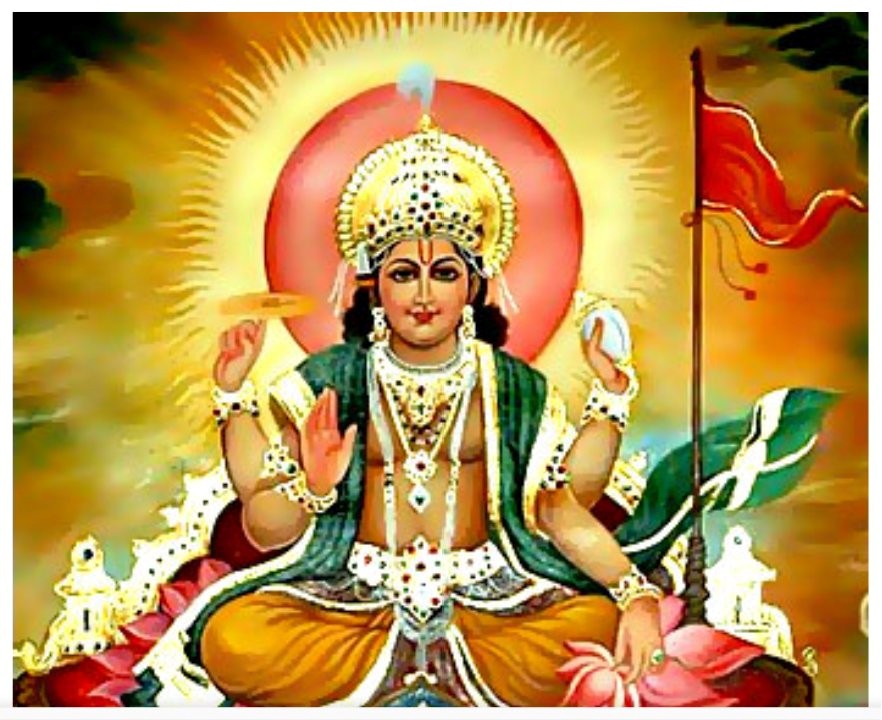
The Sun transits into Pisces from 14 March to 14 April. In this sign, the Sun manifests as Viṣṇu Āditya. The name Viṣṇu derives from the Sanskrit root viṣ (विष्), meaning “to pervade” — that which enters and sustains all existence. In the Bhagavad Gītā (Chapter 10), Śrī Kṛṣṇa declares, “Among the Ādityas, I am Viṣṇu,” establishing Viṣṇu as the foremost sustaining principle among the solar intelligences.
Viṣṇu Āditya restores balance by subduing adharma. The root viṣ also carries the sense of entering and overcoming disorder, the quiet force through which imbalance is corrected and dharma is re-established when arrogance, excess, or tyranny take hold. The story of the asura king Mahābali illustrates this principle. Viṣṇu, in the form of the dwarf brāhmaṇa Vāmana, subdued pride not through brute force but through divine strategy. In his Trivikrama form he reclaimed the three worlds in three strides, restoring cosmic order. During this transit, worship of Trivikrama is traditionally advised for protection against tyranny and unjust dominance.
Sun in Pisces, as Viṣṇu Āditya, embodies the cyclical principle of restoration, rebalancing, and renewal. What is no longer aligned with dharma is gradually cast out. Pisces, being the twelfth sign of the zodiac, signifies dissolution, surrender, retreat, and ultimately liberation. Yet in the presence of Viṣṇu Āditya this dissolution becomes a sacred clearing — preparing the ground for renewal and the restoration of balance.
This principle is expressed in the Bhagavad Gītā (4.7), where Śrī Kṛṣṇa declares:
यदा यदा हि धर्मस्य ग्लानिर्भवति भारत ।
अभ्युत्थानमधर्मस्य तदात्मानं सृजाम्यहम् ॥
yadā yadā hi dharmasya glānir bhavati bhārata
abhyutthānam adharmasya tadātmānaṁ sṛijāmyaham
“Whenever there is decline of dharma and rise of adharma, I manifest Myself.”
At the individual level, this transit invites clarity and purification in the affairs of the twelfth house – releasing what must end, resolving karmic residues, and preparing for renewal. Ketu, the mokṣa-kāraka and co-significator of transcendence, reinforces this theme of detachment and spiritual orientation. Chanting the twelve-syllable mantra of Viṣṇu, particularly in relation to the planet occupying one’s twelfth house, can help align intention with dharmic direction and inner clarity.
Transits
The new Samvatsara Parabhava begins amid structural strain, with the Sun–Saturn conjunction in Pisces testing leadership while the Mars–Mercury–Rahu alignment in Aquarius continues to sustain global tension.
Parabhava, meaning “defeat” or “downfall,” begins when Sun and Moon are conjunct in Pisces on 19 March. Traditionally, it is associated with conflict, fire, weaponry, disease, sorrow, and heightened vulnerability among intellectuals, the marginalised, and livestock. Its symbolism aligns closely with the present global climate, characterised by war, geopolitical tension, trade disputes, strategic rivalry, and increasingly fragmented cooperation as the year unfolds.
The Sun joins exalted Venus and Saturn in Pisces. The Sun–Saturn conjunction on 25 March is referred to as Pitru Dosha, a challenging combination caused by a lack of ancestral blessings, often resulting in inadequate foundational support and protection in life. In mundane terms, this conjunction indicates strain between leadership or rather executive authority and institutional machinery. Confidence in leadership may be tested through corruption narratives, opaque agreements, or erosion of public trust. Exalted Venus tempers immediate reaction and introduces a diplomatic emphasis in negotiations. However, Venus also supports a combust Saturn here, suggesting that underlying fragilities may not become fully visible until 25 March, when Venus moves into Aries.
As I wrote last month, the movement of Mars into Aquarius on 23 February resulted in two potent combinations in the sky — Śūla Yoga, a configuration of planets across three houses that often makes Mars highly operative and can lead to aggressive or forceful action; and Kala Amrita Yoga, where the planets are hemmed between Rahu and Ketu, creating heightened collective pressure on governments, institutions, and social systems. Such pressure can trigger sudden actions that may appear destabilising initially but ultimately work toward restoring order. The breaking of Śūla Yoga on 25 March, when Venus moves into Aries, may offer some scope for de-escalation in the Middle East. However, Kala Amrita Yoga will continue until Venus reaches Virgo on 1 August, suggesting that the existing tensions in the region may persist until then.
Further, Mercury, Mars, and Rahu remain in Aquarius until 1 April, a configuration that supports the continuation of the tensions, disruption, conflict, and turbulence currently visible across the world. Jupiter’s aspect from Gemini offers a mitigating influence and a willingness to negotiate, though Jupiter has only recently turned direct and its pace remains sub-optimal until 7 April.
The Mercury–Mars conjunction can be contentious, yet retrograde Mercury overcoming Mars on 15 March suggests that intellect may prevail over aggression. Mercury prevails due to superior skill and focus, applying the Rath Rule — wherein latitude, longitude, and declination are examined in determining planetary war. Mercury approaches Rahu closely but does not conjoin, as it turns direct on 20 March. As Mercury changes direction, consensus may shift rapidly, and government policy and thinking could undergo a significant reversal.
Mars leaves Aquarius to join the Sun and Saturn in Pisces on 1 April, and Mercury follows on 10 April. The period between 1 and 10 April will be particularly sensitive, as Mars with the Sun in Pisces and a combust Saturn may indicate covert manoeuvres or strategic actions aimed at managing underlying power struggles. Mars enters the orb with Saturn from 8 April, though the actual planetary war occurs only on 19 April. Jupiter’s aspect to its own sign Pisces remains stabilising and supports diplomacy and measured dialogue; however, Jupiter also receives Rahu’s aspect from Aquarius, suggesting that negotiations may unfold within a climate of strategic complexity and underlying uncertainty.
The critical configuration to watch in this period is Mars joining the Sun and combust Saturn in Pisces, marking a sensitive window in early April before their eventual confrontation later in the month.
Festivals
Ugadi, the soli-lunar New Year in several regions of India, is observed on 19 March, marking the beginning of the month of Chaitra. This coincides closely with the Vernal Equinox on 20 March at 2:46 pm (GMT), when daylight begins to increase in the northern hemisphere — a natural symbol of renewal and balance.
Rāma Navamī is celebrated on 26 March, commemorating the birth of Lord Rāma on the Navamī tithi of Chaitra Śukla Pakṣa. This is followed by Hanumān Jayantī on 1 April, observed on the full moon day. The recitation of the Śrī Rāma Rakṣā Stotram is recommended for nine days beginning from Śukla Pratipadā of Chaitra (19 March) through Rāma Navamī (26 March). This practice is traditionally undertaken for protection, courage, and the removal of visible and invisible obstacles that obstruct one’s path.
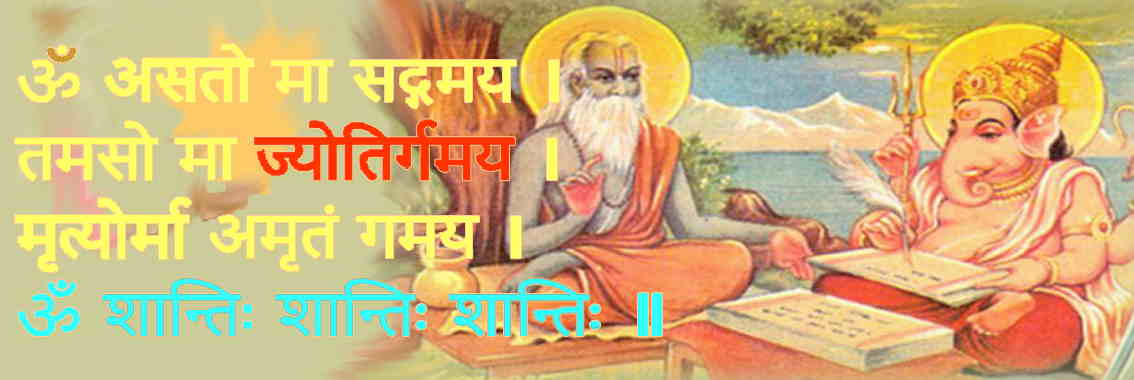
Let us to pray to Viṣṇu Aditya for expelling the darkness outside and within our minds.
ॐ घृणि: विष्णु आदित्य
om ghṛṇi viṣṇu āditya