
The Sun will transit the sidereal sign of Sagittarius from December 15, 2025, to January 14, 2026. When the Sun is in Sagittarius, we are blessed by Aṁśumān Aditya. The word aṁśumān means radiant, infinite, all-pervasive, and resplendent. The ninth house represents virtue, the path, and the people indicated by the planets placed within it, who are considered our sources of protection. Therefore, Aṁśumān is a universal protector through divine law, wisdom, and righteousness.
The Rāmāyaṇa (Book 7, Uttarakāṇḍa, Chapter 4) narrates the origin of the Rākṣasa clan. It is said that when Brahma, the creator, asked various beings to care for the world, one group responded “Rakṣāmahe” – meaning “we will protect.” From this, they came to be known as Rākṣasas. Another interpretation describes them as beings who eat even when they are not hungry, a trait also associated with the Rākṣasa nature. Today, Rākṣasas may be understood as people whose protective power arises from survival instinct and attachment, defending what they believe is theirs — whether possessions, relationships, identity, or entitlement.
Each month, every Aditya is accompanied by a Rākṣasa who follows and protects him on his journey. The Rākṣasa who travels with Aṁśumān is Vidyut, meaning lightning — forceful and unpredictable. Vidyutkeśa was born to the prominent Rākṣasa Heti (who accompanies Dhata Aditya) and Bhaya, the sister of Yama and was blessed with the splendour of the Sun. He later married Sālakaṭaṅkā, the daughter of Sandhyā, the goddess of dusk.
When their son Sukeśa was born, Sālakaṭaṅkā distanced herself from him, choosing to spend her time instead with her husband. Śiva and Pārvatī, moved by the child’s cries, blessed him to instantly grow to the same age as his mother. They further declared that henceforth Rākṣasa women would give birth immediately upon becoming pregnant, and their children would rapidly mature, reaching a state equal (in a modern sense, in mental age) to their primary caregiver, allowing them to survive without parental protection. Seen metaphorically, it echoes the experience of children who grow up too quickly, not because they are ready, but because nurture is absent and survival demands maturity before its time.
Transits
This month begins with the Sun joining Mars in Sagittarius, a combination that can inspire authority and leadership in an ideological and benevolent sign that can lead to bold and dominant action. On December 20, Venus steps into Sagittarius, introducing greater emotional sensitivity, compassion, and in some cases, more personal or private motivations behind actions. Mercury follows on the 29th, amplifying communication, purpose, and the desire for one’s voice to be heard.
With four planets gathered in Sagittarius, the sign receives intense focus. While this offers powerful potential, the concentration of energy can also create pressure, frustration, or sudden changes of direction if plans are not grounded in thoughtful strategy.
Sagittarius becomes even more significant as both Saturn and Jupiter jointly aspect the sign (Brahma Yoga), supporting creativity and measured success, however with deliberate steps rather than impulse-driven decisions.
At the same time, Mars, Venus, and Mercury remain combust, reducing the material and visible results of effort. Early January brings a notable interaction as Venus and Mars enter a planetary war between January 6-9, which Venus ultimately wins before moving swiftly ahead into Capricorn on January 12. This transition leaves the Sun, Mars, and Mercury in Sagittarius, strengthening focus and making hard decisions easier to execute.
With most planets positioned in dual signs, the broader atmosphere encourages discussion, adaptability, and sometimes indecision.
This sacred month, Mārgaśīrṣa, is traditionally dedicated to spiritual study, worship, temple visits, cleansing rituals, and acts of charity. It is a favourable time for reflection, devotion, and aligning life with higher values and intentions.
Festivals
The winter solstice falls on December 21 at 15:03 hours, marking the longest night of the year. From this point onward, the Sun appears to begin its northward journey, and the days start to lengthen. On January 3, during the full moon when the Moon is in Ārdrā Nakṣatra, we celebrate Tiruvaṭirai, also known as Ārūḍhra Darśanam, a festival honouring Śiva as Naṭarāja, whose cosmic dance symbolizes the liberation of all souls. (I have explained in 2021 the inner significance of the dance from a verse in Śivananda Laharī. – https://www.facebook.com/victory19/posts/10227798529094112)
Let us invoke the blessing of Aṁśumanāditya to grant us clarity, and the strength to uphold what is right for all and not through force but through light.
ॐ घृणि: अंशुमनादित्य
om ghṛṇi aṁśumanāditya
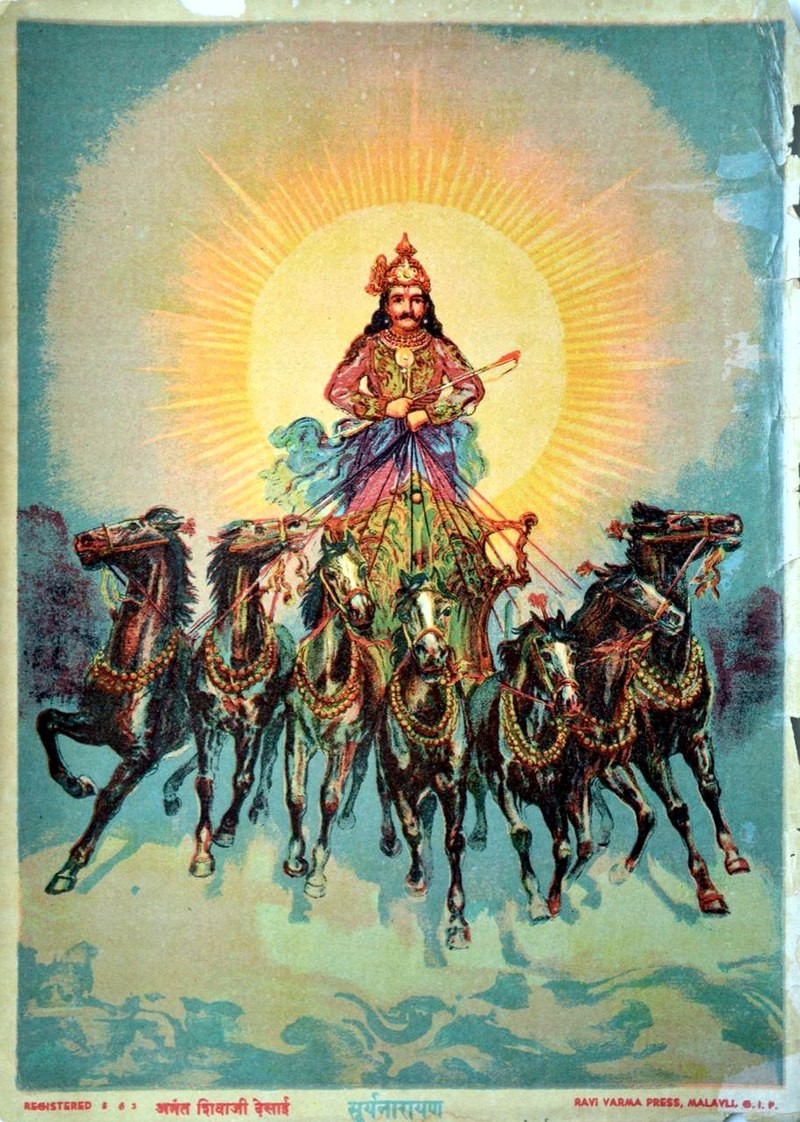
Picture of Surya Narayan by Ravi Varma from Baroda Library – Source Wikipedia