
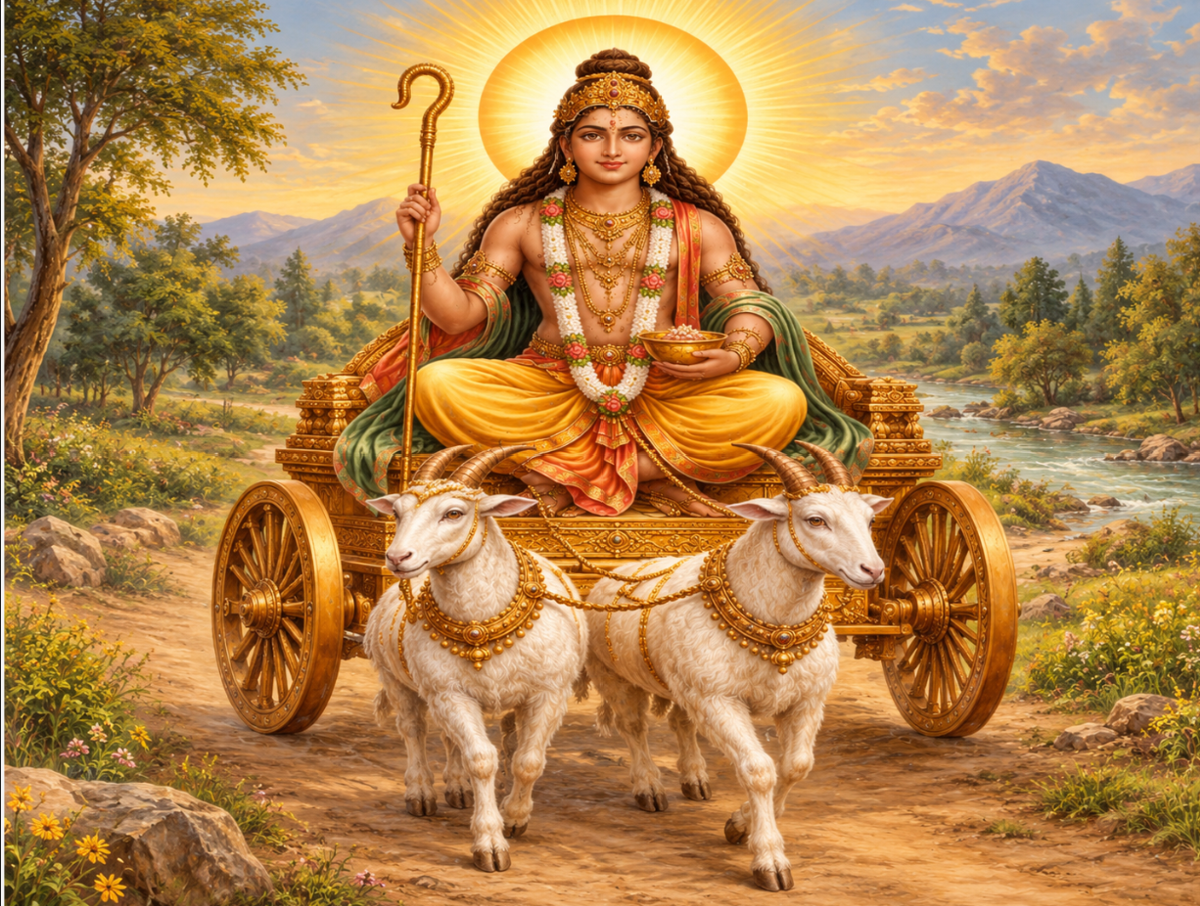
The Sun will enter the sign of Libra on 17 October and will remain in it until 16 November. The Āditya blessing the sign is Pūṣan, whose name expresses his essential nature: puṣṇāti sarvān iti pūṣā, “he who nourishes all”. In the Ṛgveda, Pūṣan is a beneficent deity, strong, swift, bright and radiant. He is invoked as īśānaṃ rāyaḥ, lord of wealth, and Pathaspati, lord of paths, reflecting his roles as both provider and guide.
Pūṣan is invoked to protect travellers from wolves, robbers and other dangers and to bring them safely to their destination. Yet he is Pathaspati not merely because he protects the traveller, but because he knows the paths. His distinctive chariot is drawn by goats, sure-footed animals capable of negotiating difficult terrain. Pūṣan therefore represents the experienced guide who knows the way because he has travelled it himself. His guidance also extends to the path of knowledge, where he is invoked to lead the seeker to the wise person who can remove doubt and recover what has been lost.
The Sun in Libra carries the potential of Pūṣan as benefactor, guardian of prosperity and guide. Libra is associated with business, profit and growth and is described as nidhi rāśi, a source of wealth and prosperity. Those with the Sun in Libra may also express his capacity to illuminate the path for others and provide guidance in times of uncertainty, qualities that may become particularly visible when the Sun occupies the seventh house.
Yet Libra, the natural seventh house, is also a māraka house associated with departure and the dissolution of the individual ego. It is the house of relationships, pleasure and worldly enjoyment, where attention naturally turns away from the self towards others. This offers one way of understanding the Sun’s debilitation in Libra. The mythology of Pūṣan carries a similar warning: at Dakṣa’s sacrifice his teeth are broken, symbolically curbing excessive enjoyment and indulgence.
Transits
The Sun joins Venus and Mercury in Libra, where it is debilitated. With Venus, the ruler of Libra, also in the sign, maintaining relationships and balance takes precedence over authority and individual will. Venus becomes combust on 19 October, with the exact Sun–Venus conjunction on 24 October in Chitrā nakṣatra, the same day that Mercury turns retrograde. The Sun–Venus conjunction in Chitrā brings a need to realign intention with its outward expression.
With both Venus and Mercury now retrograde, considerable rajasic energy is directed towards revising, renegotiating and correcting what is already in motion. On 5 November, Venus retrogrades into Virgo, its sign of debilitation, although by retrograde motion it gives the results of Pisces. Venus and Mercury are now in exchange, while Venus also strengthens Saturn in Pisces. Compromise may be difficult, but the pressure is towards arrangements that are more workable and sustainable. Venus turns direct on 14 November.
The significant transit this month is Jupiter’s entry into Leo on 31 October. This will be a relatively brief stay, lasting only until January 2027. Jupiter in Leo is enthused with action and victory. However, on 11 November, Jupiter meets Ketu in Maghā nakṣatra. This is a high-intensity conjunction. Jupiter represents wisdom and expansion, while Ketu severs, detaches and brings release. With the two moving directly towards each other, what has been expanding can meet an abrupt check, forcing sudden closures, reversals or the cutting away of what can no longer be sustained.
Maghā adds another dimension. Associated with the Pitṛs, it carries the symbolism of ancestry, authority and the throne, while its śakti is tyāga, the power of letting go. The conjunction may therefore be particularly significant for established structures of authority, inheritance and succession.
The period becomes more volatile with Mars at gandānta in the final degree of Cancer on 11 November, just as Jupiter meets Ketu. Mars enters Leo on 12 November, bringing all three planets into close proximity. Mars then enters a prolonged planetary war with Jupiter between 13 and 18 November and emerges victorious. This is a potentially dangerous combination: aggression, haste and force can overpower judgement and wisdom, while Ketu adds an element of severance and unpredictability. The Sun is also weakened at rāśi sandhi before entering Scorpio on 16 November.
This is only the first in a series of Jupiter–Ketu conjunctions, which will continue in Cancer during 2027. Each meeting has a different dynamic, depending on whether Jupiter is direct or retrograde, the relative degrees of the two planets, and whether Jupiter is moving towards Ketu, chasing it from behind or moving away from it. A head-on encounter can bring severe disruption, while separation may be materially favourable. When retrograde Jupiter chases Ketu from behind, however, judgement and discernment may become clouded, with the risk of losing independence of thought.
This is also the last complete solar month with Rahu in Aquarius and Ketu in Leo before the karmic axis shifts to Capricorn and Cancer in early December. Rahu’s transit through Aquarius has been particularly productive for technology, artificial intelligence and research. Jupiter’s aspect from Leo may give these areas a further boost before the nodes change signs.
Festivals
The nine-day festival of Navarātri ends on 20 October with the celebration of Dusshera or Vijayadaśamī, marking the victory of good over evil. Another notable day is Sarasvatī Pūjā on 19 October, when the goddess of learning is worshipped.
We celebrate Deepavali, the festival of lights which is symbolic of victory over evil on 8 November. This festival is celebrated on Amavasya tithi in the North of India as Lord Rama’s return to Ayodhya after vanquishing Ravana, along with the Lakshmi Puja. In the South of India, the festival is always celebrated on Chaturdashi tithi in the morning or the night before.
Let us worship Pūṣan Āditya, that he may sustain us through uncertain times and guide us safely along the path ahead.
ॐ घृणिः पूषणादित्यः
om ghṛṇiḥ pūṣaṇādityaḥ