
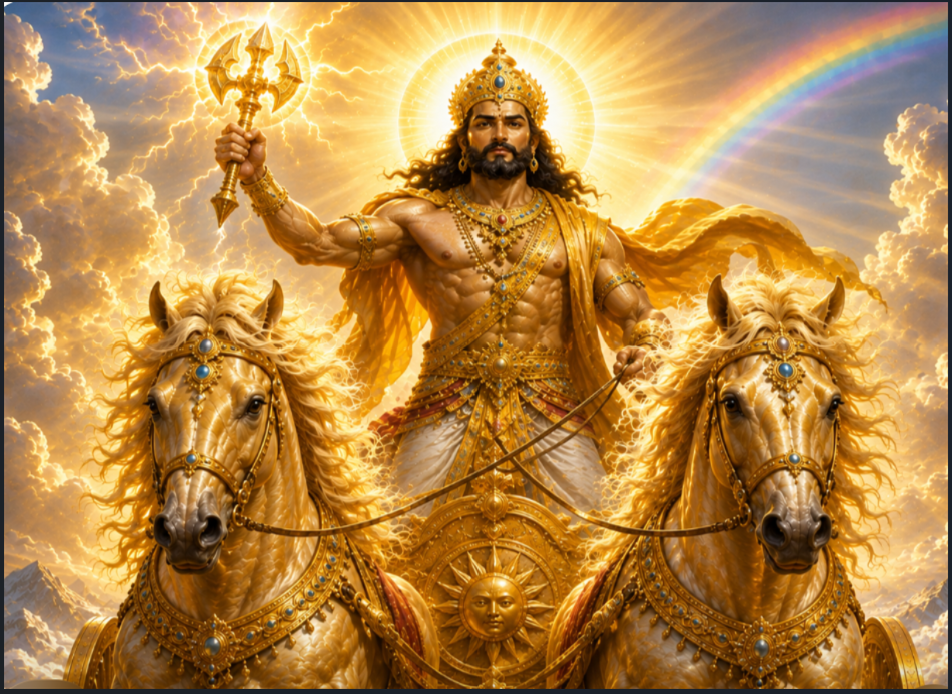
The sun enters Leo on 17 August and will stay in the sign until 16 September. The Aditya for the sign is Indra, the lord of the heavens . The name Indra is derived from the root “in/inv” meaning “to subdue” or “to conquer. In the Rg Veda, he is most often depicted riding a brilliant chariot drawn by his two tawny steeds with his weapon Vajra, a thunderbolt. Indra is called Śakra, embodying power and capability and Maghavan when he is the bountiful lord who is generous and graceful. The possession of these two qualities, power and generosity constitute true royalty.
Indra’s most celebrated deed in the Rgvedic hymns is the slaying of the serpent-demon Vṛtra who had imprisoned the essential resources of waters and cattle within a mountain cave. Through the defeat of Vṛtra (RV 1.32.1–2), Indra appears as a heroic warrior and a divine power that overcomes obstruction and re-establishes the proper flow of life.
The Sun in Leo carries the potential of Indra where the leadership will be based not merely upon power, but upon the competence, legitimacy, and merit required to attain and sustain it. When Sun occupies the fifth house, many of these qualities of competence, protection, generosity may gain prominence. Indra’s position is nevertheless precarious due to continual pressure of competition and emerging challenges. Leadership must justify and continue to preserve itself. This is the classic trap of saṃsāra where one is bound by twin acts of acquiring and preserving (yogakṣema). The fifth house is also a house of discernment that calls for victory not through force but by perseverance, self-reflection and mastery of senses. Such a transformation often leads to qualities of stillness, humility and surrender that helps overcome one’s obsession with identity (ahaṃkāra). A leader then, may become like the wise Indra from Kena Upaniṣad who recognised Brahman as the true source of power.
Transits
Sun enters into its own sign of Leo, where it joins Ketu to form Śiva Yoga of knowledge. While the Sun represents authority, identity and rulership, Ketu loosens attachment to ego (ahaṃkāra), reminding us that true leadership arises not merely from power but from wisdom and humility. Sun in Leo exercises its natural authority with respect to governance with confidence and purpose. This favours principled leadership, decisive action and the willingness to assume responsibility. At the beginning of the month, Leo also benefits from Śubha Kartarī Yoga, being enclosed between Jupiter and Mercury in Cancer on one side and Venus in Virgo on the other. Leaders, Leo Ascendants and Leo Moon signs may find that resources, guidance and opportunities become more readily available to them. The guidance, however, is not of a single kind. Leaders may therefore find themselves balancing idealism against expediency.
The counsel given by Jupiter and Venus is fundamentally opposed. Jupiter offers counsel grounded in dharma, long-term welfare and higher principles, whereas Venus offers practical, self-serving and agenda-driven counsel concerned with preserving existing interests. Their opposing philosophies are further magnified by their respective dignities. Jupiter, exalted in Cancer will strengthen idealism. Yet, being hemmed between Mars on one side and the Ketu and Sun on the other, principled judgement may be constrained by sudden conflict. Venus, on the other hand occupies its sign of debilitation in Virgo demanding even more pragmatism. Hemmed by Mars from Gemini together with retrograde Saturn from Pisces. Diplomatic efforts may therefore be practical rather than visionary, and negotiations may proceed under considerable strain.
Mercury remains in Cancer until 22 August, after which it joins the Sun and Ketu in Leo. The conjunction of the Sun and Mercury enhances intellectual clarity and skill; however, Mercury has to meet with Ketu on 27 August that can lead to abrupt shifts in stance. This is followed almost immediately by the lunar eclipse of 28 August in the 2nd pada of Śatabhiṣā Nakṣatra. Eclipses in this nakṣatra often coincide with revelations, public scrutiny and the exposure of weaknesses that require collective attention.
The atmosphere becomes noticeably lighter in September. On 2 September Venus enters its own sign of Libra, restoring dignity and forming Mālavya Mahāpuruṣa Yoga that brings abundance and enjoyment. Libra governs diplomacy, commerce, negotiation and the marketplace, making this a constructive influence for financial markets, international relations and the restoration of balance. The effects are particularly favourable for the movable signs of Aries, Cancer, Libra and Capricorn, where Venus occupies a kendra. Its expression will naturally depend upon the house occupied by Libra in the natal chart. For Aries this emphasises relationships, for Cancer the home, for Libra the self, and for Capricorn career and public responsibilities.
On 7 September Mercury enters Virgo, its sign of exaltation, producing Bhadra Mahāpuruṣa Yoga for the dual signs. Having emerged from combustion and the influence of the lunar nodes, Mercury is better able to express its natural qualities, making communication clearer and negotiations more productive.
Festivals
We have a plethora of festivals and ceremonies to observe this solar month. Nag Panchami is observed on 17 August to fast and pray for relief from afflictions associated with the nodes. Married women fast and pray for prosperity and longevity of their husbands and families on Vara Lakshmi Vratam on 21 August. Harmony between siblings is celebrated as Raksha Bandhan on the 27 August. The same day is auspicious for Yajur Veda Brahmins families as they recite the Gayatri mantra and change the sacred thread worn by them. This festival will be celebrated a day later in India, the dates determined by tithi at sunrise.
The lunar eclipse in Śatabhiṣā Nakṣatra is in the sign of Aquarius on the early hours of 28 August. The eclipse starts at 3.34 hours and will be visible in London after the eclipse reaches its maximum magnitude at 5.31 hours, the Moon sets at 6.10 hours long before the partial eclipse ends at 6.51 hours.
Janmashtami, the birthday of Krishna will be observed on Friday September 4 during the Kṛṣṇa pakṣa Aṣṭamī tithi of month of Śravaṇa. We celebrate Ganesha’s birthday on Śukla caturthī of Bhādrapadā month on 14 September. It is a powerful day to propitiate Lord Ganesha for removing the obstacles in life.
The BAVA’s yearly online conference on Secrets of Nava Graha (17 Sept – 21Sept) is available to the members free. Become a member before 31 August to access the conference.
Let us pray to Indra Āditya to inspire responsible leadership and excellence in the world.
ॐ घृणिः इन्द्र आदित्य
om ghṛṇiḥ indra āditya