
Jupiter–Ketu Conjunctions 2026–2027: Three Encounters, Three Different Conditions

The conjunction of Jupiter and Ketu is traditionally associated with spiritual awakening, detachment and the pursuit of higher knowledge. Jupiter represents wisdom, dharma, prosperity and the principles that sustain society, while Ketu is associated with mokṣa and renunciation.

Yet the conjunction does not invariably produce spiritual upliftment or favourable material results. Much depends on Jupiter’s dignity, the influence of other planets, the nakṣatra and, importantly, the manner in which the planets meet. A head-on encounter may bring severe disruption, while separation may be materially favourable. When retrograde Jupiter approaches Ketu from behind, judgement and discernment may become clouded, with the risk of losing independence of thought.

Two classical principles are relevant here. The Bṛhat Parāśara Horā Śāstra (37.16) describes how the nodes absorb and amplify the nature of planets they conjoin, while the Jātaka Pārijāta (6.6) draws attention to the breakdown in moral framework when Jupiter is in debilitation or afflicted and associates with a debilitated planet.

Between November 2026 and April 2027, Jupiter and Ketu meet three times, first in Maghā in Leo and subsequently twice in Āśleṣā in Cancer. Mars is an important modifying influence throughout this period. Its conjunctions with Ketu and Jupiter in Leo intensify the exercise of leadership and executive power, in contrast to its later debilitation in Cancer. 

The closest historical parallel examined is 1932–33, when Jupiter, Ketu and Mars were also involved in Leo, during a period of significant changes in political authority and financial control.

The Four Movements of Transit

Ketu moves retrograde through the zodiac, while Jupiter periodically changes direction. Their relative movements therefore create different forms of conjunction and separation. The following illustration applies the principles of Saṃyoga taught by Pandit Sanjay Rath to this Jupiter-Ketu conjunction.
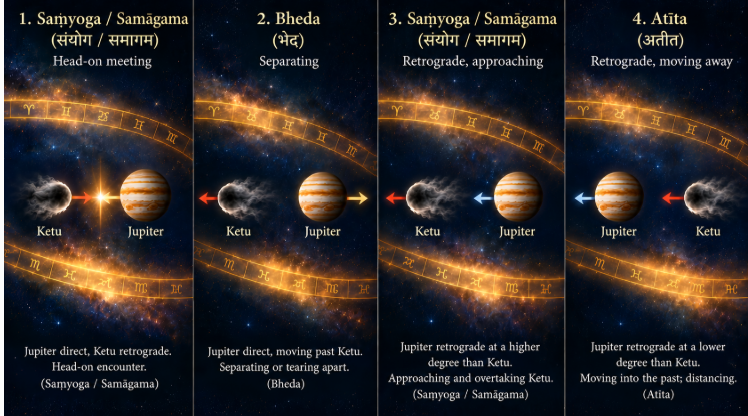
The table below breaks down my interpretation on exactly how these four movements will play out across the upcoming 2026–2027 encounters.

Jupiter – Ketu Conjunction Time Line November 2026 to June 2027
Period Movement Effect
31 Oct – 11 Nov 2026

(Exact Conjunction: 1° 18′ Leo- Maghā )

Saṃyoga – Head on collision Sudden volatile developments; maximum intensity with friction unavoidable structural shifts or realignment of political alliance sudden closures of legal  or financial matters
11 Nov – 13 Dec 2026*(1) Bheda  – Separating Drifting apart, temporary breaking  free from obstacles, unobstructed material and intellectual expansion
13 Dec 2026 – 1 Mar 2027** (2)

Exact Conjunction: JP Rx 25°27′ Cancer – Āśleṣā )

Saṃyoga – retrograde approaching Reopening unresolved matters; Halting forward momentum entirely. Re-audit of beliefs and re-evaluation of wealth or projects, collective logic can buckle under narcissistic leadership
 1 Mar – 13 Apr 2027 Atīta – retrograde moving away Revisiting the past; internal processing, repetition, dealing with deeply buried unfinished business autonomously. Creates a window for massive whistleblowing operations and  leaks of classified institutional secrets and forensic audits
13–20 Apr 2027***(3)

Exact Conjunction: JP St 22°50′ Cancer – Āśleṣā )

 Saṃyoga – Head on collision Absolute settlement and systemic realignment. capitulation,  total cessation of resistance, allowing for binding agreement, structural treaty, or financial settlement to be smoothly executed.
20 Apr – 26 Jun  2027 Bheda – Separating Separation; karmic debt paid, resolution and forward movement, materially good
*(1)Jupiter in Leo and Ketu in Cancer from 6 Dec 2026-25 Jan 2027; Jupiter turns retrograde on 13 Dec 2026
**(2) Jupiter crossing gandanta from Leo and moving back to Cancer on 25th Jan 2027
***(3) Jupiter is stationary in the conjunction as it turns turns direct 13 Apr 2027

Three Encounters, Three Different Conditions

The three Jupiter–Ketu conjunctions suggest a progression from open confrontation to the exposure of underlying problems, followed by an attempt at resolution or restructuring.

November 2026 is potentially the most explosive period, with a head-on Saṃyoga in Maghā, followed by Mars conjoining Ketu on 16 November and Jupiter on 19 November in Leo. Mars also casts its eighth aspect on Saturn in Pisces, adding tension between executive action and established institutional structures. This could precipitate sudden changes in political leadership, alliances, institutional authority or financial arrangements. Maghā’s Tyāga Śakti, the power of relinquishment, adds the possibility of surrendering authority, privileges or established positions.

March 2027 presents a different situation. Jupiter approaches Ketu in retrograde motion in Āśleṣā, while debilitated Mars returns to Cancer. Rather than an entirely new crisis, this period may expose the deeper consequences of earlier developments. Unresolved disputes, concealed weaknesses and financial or institutional irregularities may resurface, leading to obstruction, investigation and the unravelling of existing arrangements. Āśleṣā’s Viśleṣaṇa Śakti, the power of separation or disentanglement, reinforces this possibility.

April 2027 brings the final encounter in Āśleṣā after Jupiter and Mars have resumed direct motion. Jupiter is exalted in Cancer, while Mars remains debilitated and in the background. This suggests a difficult but potentially decisive settlement or structural realignment, perhaps requiring significant concessions rather than a restoration of the previous order. The subsequent separation of Jupiter and Ketu after 20 April may permit renewed forward movement.

Historical Precedents: The Importance of Planetary Context

Historical Jupiter–Ketu conjunctions provide an opportunity to examine how similar planetary configurations have accompanied major political and economic developments. The periods of 1932–33 and 1990–91 are particularly interesting because both involved Leo and Cancer, yet produced very different outcomes. The former witnessed the concentration of political power and restrictions on financial freedom, while the latter saw the dissolution of established political structures and greater economic integration.

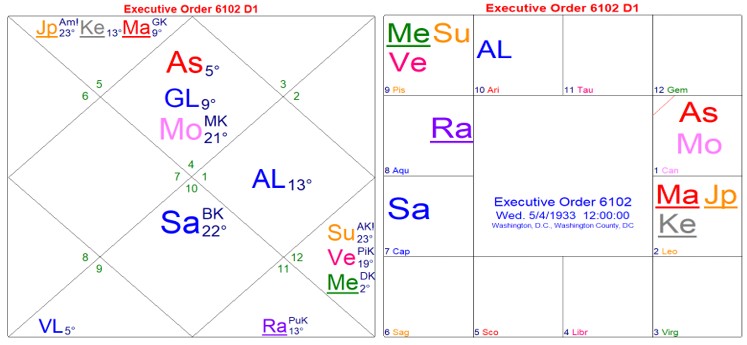
The early 1930s were marked by the Great Depression, the rise of authoritarian movements and unprecedented government intervention in financial affairs. In April 1933, the United States issued Executive Order 6102, requiring citizens to surrender most privately held monetary gold under threat of legal penalties.

On that day, Jupiter, Mars and Ketu were all retrograde. Jupiter and Ketu were in Atīta, a period of separation and reconsideration, while retrograde Mars approached Ketu from behind in Saṃyoga. This combination suggests a weakening of collective resistance in the face of strong executive authority. Mars and Ketu were in Maghā, whose Tyāga Śakti signifies relinquishment or sacrifice. The compulsory surrender of gold offers a striking expression of this symbolism. The exchange between the Sun and Jupiter further connects executive authority with wealth and the extraordinary government intervention represented by Executive Order 6102. The Moon in Āśleṣā suggests collective paralysis in the face of executive action.

During the same period, Adolf Hitler was consolidating his authority and dismantling the institutions of the Weimar Republic. The parallels with 2026–27 are therefore particularly relevant to questions of executive power, financial control and the influence of Mars.
The period around 1990 presents a contrasting picture. Germany was reunified, Soviet authority weakened, and political and economic relationships across Europe were transformed. At the time of reunification on the 3rd October 1990, Jupiter was exalted in Cancer and occupying Puṣya, whose śakti is associated with nourishment and growth. Jupiter  was moving ahead of Ketu in Bheda, the separating phase. This movement suggests release from karmic debt and constraints and the possibility of material progress. The move of Saturn in Capricorn towards the end of that year provided a further influence of discipline and structural reorganisation. The eventual dissolution of the Soviet Union and the subsequent economic integration of formerly separated countries illustrate a different expression of the Jupiter–Ketu cycle.
Prince Harry: The Unfinished Karma of the Exiled Prince

Prince Harry is apparently making a comeback in Britain. The interesting question is not whether he can return but to try and understand why the pull of Britain remains so strong.

I have never been convinced that Harry’s departure represented the completion of his karma with the UK. When I discussed his horoscope in a BAVA presentation  – Role of Karma Tara in 2022, I ended by saying precisely that: “As far as his karma with UK is concerned, it’s not over yet. Watch this space.”

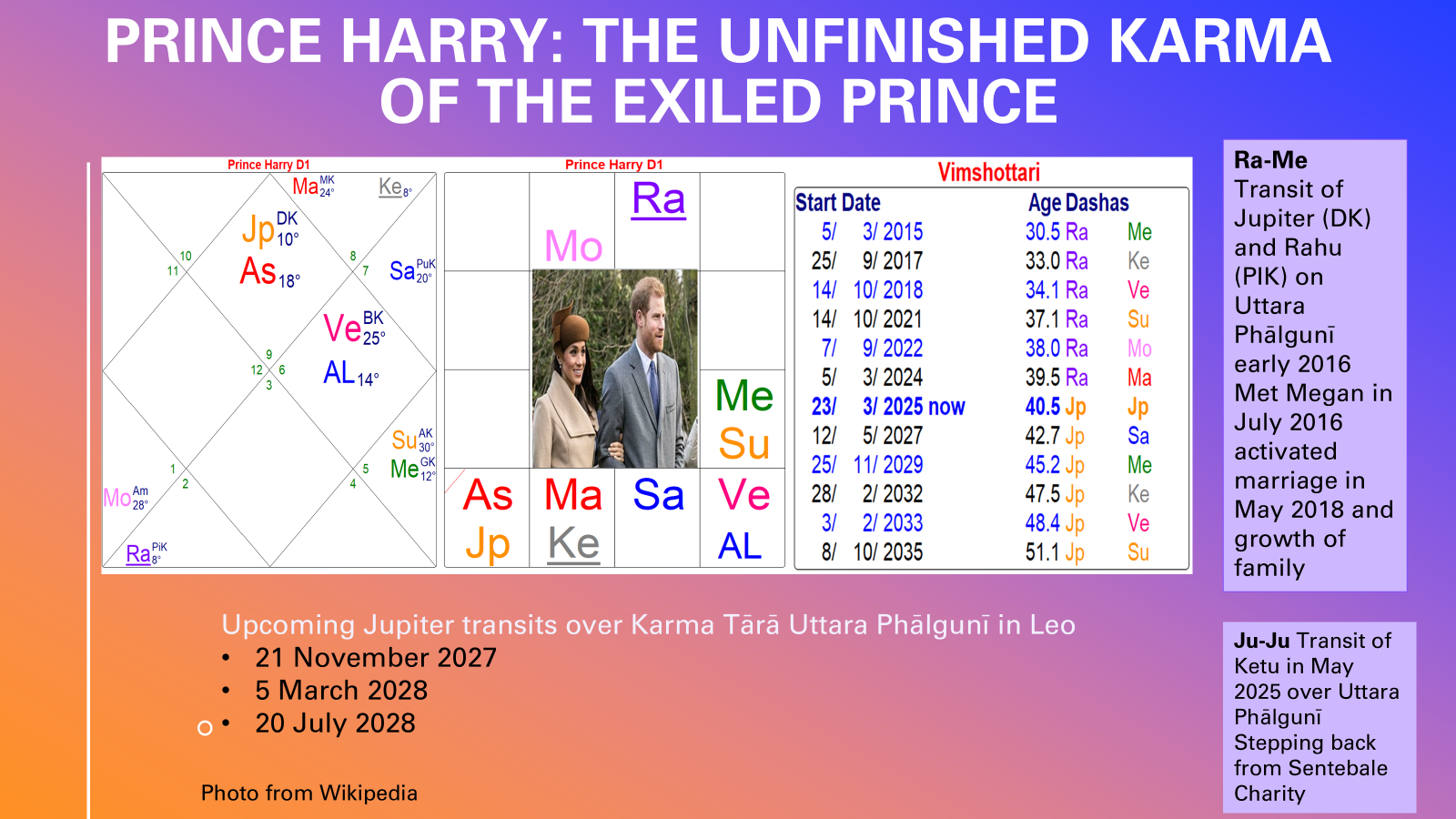
The reason lay partly in the commencement of Jupiter daśā in 2025 and his Karma tara Uttara Phālgunī  in Leo . Karma Tārā is the tenth nakṣatra from the Moon and carries the memory of the karma we are meant to perform.


Marriage changed the direction of his karma

Harry’s Moon is in Kṛttikā, making Uttara Phālgunī his Karma Tārā. His Sun at 29°19′ Leo falls in Uttara Phālgunī and is also his Ātmakāraka. This makes the Karma Tārā unusually important: it contains the planet representing the deeper direction of the self.

Uttara Phālgunī ‘s deity is Aryaman, associated with marriage, kinship and the obligations created through relationships. Aryaman also protects these bonds from hostile forces and seeks to make their path anṛkṣaraḥ, “free from thorns”. 

This was particularly true in Harry’s case. Marriage did not simply give him a wife and family; it changed the direction of his karma. Whatever one’s view of his decisions, Harry clearly believed that he was protecting his wife and family, even when doing so brought him into conflict with his inherited obligations to the Royal Family. He so wanted to prevent the situation that he felt that his mother Princess Diana found herself in. That itself belongs very naturally to Aryaman.

The eclipses of 2019 marked the developing rupture. Two fell in Sagittarius, the Ascendant of Harry, William and the Queen, while the December total solar eclipse in Mūla was particularly significant for Harry, activating the nakṣatra of Jupiter, his Lagna lord. By October, Harry had already publicly acknowledged the growing distance from William, saying that they were “certainly on different paths at the moment”, and by January 2020 he had stepped back from royal life.

Exile did not produce detachment

At the Leeds Astrology Conference – “Discovering the anatomy of the mind” in 2023, I described Harry as  someone who had lost his homeland, his job and purpose. I also described  his behaviour as akin to an insecure, anxious and avoidant pattern. Yet what happened afterwards made the ambivalence increasingly obvious. Harry left, but continued to speak about the institution he had left. Spare itself demonstrated how psychologically present the Royal Family remained. This was not detachment. It was displacement. That distinction matters. A person who has completed something can walk away from it. Harry appeared unable either to remain within his old world or to become entirely free of it.

There was already an indication of this in an analysis I published in January 2020 on my website “Wither Prince William and Harry”, when I examined the Drekkana (sibling) charts of Harry and William. From the analysis it emerged that Harry’ sought William’s approval and that, despite their capacity for conflict, Harry retained a strong instinct to protect his elder brother. William’s D3 did not show the same degree of commitment towards Harry.

The subsequent breakdown in their relationship therefore does not necessarily contradict Harry’s attachment. In some ways it demonstrates it. Anger, accusation and repeated engagement can coexist with a powerful desire for connection.

The problem for Harry has perhaps never been simply leaving the Royal Family. It has been finding an identity once he had left it.

Then came Ketu

This is why the transit of Ketu in 2025 interests me.  Harry’s Ātmakāraka Sun sits at 29°19′ Leo in his Karma Tārā. Ketu crossed that Sun on 18 May 2025.

Ketu separates. It can remove the structures through which identity has previously been expressed. And Harry had already experienced an extraordinary stripping away of identity: prince without a working royal role, soldier without his former military appointments, son and brother living thousands of miles from his family. Around the Ketu transit another connection with purpose was severed when he stepped away from Sentebale, the charity he had co-founded in memory of his mother.

By 2025 Harry had been abroad for years. The more interesting question is what remained when the process of separation had run its course. And this is precisely when his planetary period changed.

Jupiter daśā

In both my earlier presentation at BAVA and at Leeds, I specifically noted the possibility of shift in stance  with Jupiter daśā that would begin in 2025. That period has evidently arrived.

Jupiter is both Harry’s Lagna lord and 4th lord, strongly placed in the Lagna. The 4th house represents the mother as well as the motherland, and Jupiter here carries the mother’s blessing. It is therefore interesting that during Jupiter daśā support for Harry in Britain appears to be coming through his mother’s family, particularly Earl Spencer.

There is also an earlier Jupiter activation worth remembering. In January 2016, Jupiter stationed exactly at 29°10 in Uttara Phālgunī before turning retrograde on Harry’s Karma Tārā, and on 11 February Rahu exactly crossed the Karma Tārā. Then there was conjunction of Jupiter and Rahu in adjacent star Purva Phalguni in in June 2016. Soon after Harry met Meghan in July 2016.

Rahu was particularly appropriate. Meghan was foreign, unconventional and outside Harry’s established social world. Rahu describes the disruptive and boundary-breaking way in which the karma of marriage entered his life.

The śaktis of the two Phālgunīs also work together. Pūrva Phālgunī carries the reproductive energy associated with union and procreation, while Uttara Phālgunī carries cāyanī-śakti, the power through which something gathers until its phala is realised. The meeting was therefore only the beginning. Marriage and children followed, while the wider consequences of the relationship progressively transformed Harry’s family relationships, public role and connection with his homeland.

That earlier activation is important because Jupiter is now heading towards the same Karma Tārā. This time it will go further and cross Harry’s Ātmakāraka Sun at 29°19′ Leo three times – 21 November 2027, 5 March 2028 and 20 July 2028

This is the transit I am watching. Jupiter, his Lagna and 4th lord, will repeatedly activate his Ātmakāraka in the Karma Tārā during Jupiter daśā.

Coming home may mean more than returning

It would be tempting to predict that Jupiter will simply restore Harry to royal life. The more interesting possibility is a restoration of purpose, belonging and connection with the motherland. 

The 2016 activation of the Karma Tārā preceded a relationship that changed the direction of Harry’s life. The coming activation occurs under very different circumstances: Jupiter is now the daśā lord, and it will cross the Ātmakāraka itself three times.

The Ātmakāraka represents the deeper purpose and direction of the individual, while Jupiter as Lagna lord represents Harry himself and, as 4th lord, connects him with mother, homeland and belonging. Jupiter’s repeated transit over the Ātmakāraka can therefore activate questions of identity and purpose while simultaneously bringing the themes of the 4th house into that process.

There is another layer to Jupiter’s role. Natal Jupiter is in Mūla, whose śakti uproots what must be removed for new growth to become possible. Jupiter daśā may therefore restore purpose and belonging, but not necessarily by restoring Harry’s old life. Something may first have to be uprooted and reconstituted in a different form.

The present talk of a comeback may therefore be only the beginning. The period I would really watch is November 2027 to July 2028.

This does not necessarily suggest an easy period. Harry is running Scorpio Nārāyaṇa Daśā until September 2030, carrying the turbulent and disruptive energy of Mars and Ketu. Cancer follows from 2030–33 and may bring further transformation, but I would look to the subsequent Gemini period for greater clarity and light.

Solar Eclipse Update – Revisiting Zelenskyy’s horoscope two years on

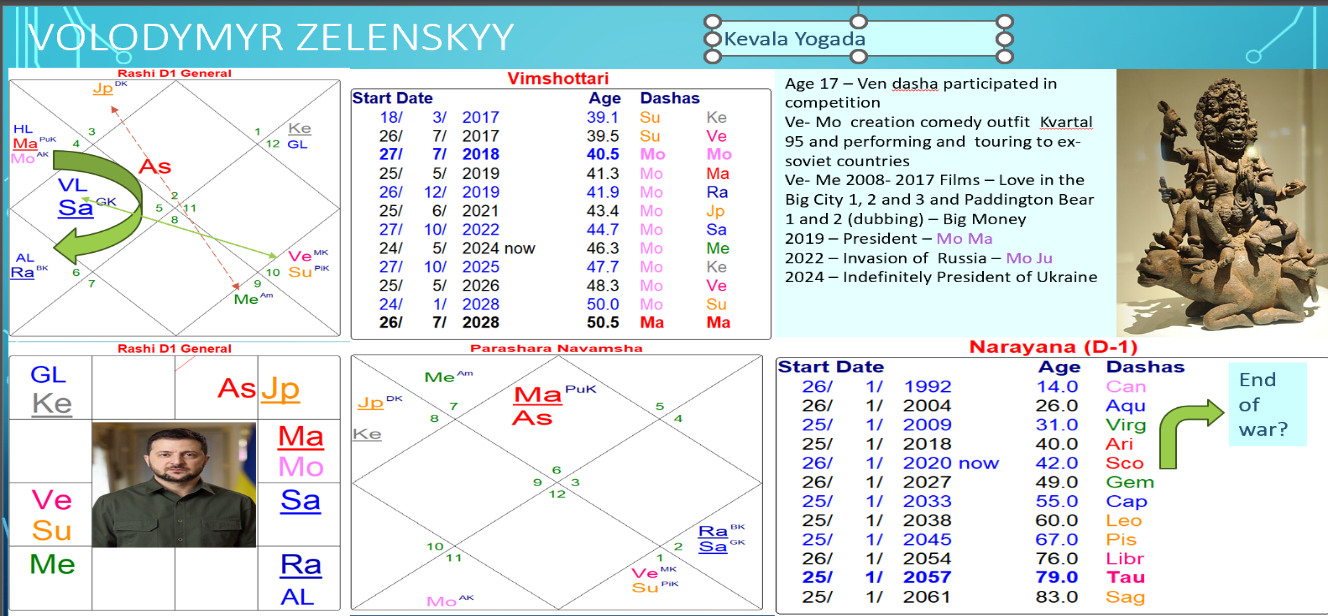
The attached slide is from my BAVA Conference presentation in October 2024 on Kevala Yogada, where I used President Volodymyr Zelenskyy’s chart as one of the case studies. At the time, my interest was in understanding why certain individuals find themselves drawn into circumstances far greater than their own personal interests, where perseverance, sacrifice and steadfastness become central to fulfilling their dharma.

In this chart, the Ātmakāraka Moon is in its own sign and is also the Lagna lord (Moon being the co-ruler of Taurus), giving rise to Kevala Yoga. Since the Moon is connected to the Lagna, it becomes Kevala Yogada, linking the mind with the deeper purpose of the soul. The strength of that conviction can become a powerful force for change, but it can equally make such individuals difficult to deflect from the course they have chosen.

The configuration of planets in 3rd, 4th and 5th houses is  associated with exceptional tapasya, courage and endurance (Yama Yoga). Combined with the Moon-Mars conjunction, it explains the extraordinary determination and resilience that have characterised his leadership during the conflict. The  Moon AK signifies the mind, emotional resilience and public support. But its conjunction with Mars brings the ability to combat. Looking at the events of the past few years, these qualities are reflected in the way Zelenskyy has continued to pursue his chosen course despite extraordinary national adversity and human loss.

As I noted in the lecture, every major development in Zelenskyy’s public life unfolded during Moon daśā that commenced in 2018, consistent with the Moon being both the Ātmakāraka and Kevala Yogada. I also suggested that although Mars daśā that will be commencing from July 2028 might bring a different expression of the same purpose, the more significant  change in the external environment would come with Gemini Nārāyaṇa Daśā in January 2027.

I had pointed out that the Yama Yoga  involving the 3rd, 4th and 5th houses can sometimes be modified by strong influences operating from either side. In Zelenskyy’s horoscope, I identified the Jupiter-Mercury exchange as providing that mechanism, becoming activated with the onset of Gemini Nārāyaṇa Daśā. At the time, I suggested that this might coincide with increased US involvement, peace negotiations, or even Zelenskyy leaving Ukraine for the United States, marking a significant shift in the course of the conflict.

Why revisit this chart now?

The solar eclipse of 12 August 2026 falls in Āśleṣā, directly activating Zelenskyy’s natal Moon, which is the Lagna lord, Ātmakāraka and the very planet that forms the basis of his Kevala Yogada.

Given the Moon’s central role in this chart, I regard this eclipse as a harbinger of a significant turning point. Eclipse effects typically unfold across a six-month window, and looking at his natal Moon’s degree, I would say the months following the eclipse are extremely critical. For Zelenskyy, matters relating to leadership, public standing and judgement may undergo profound change. This period assumes even greater significance in light of the February 2027 solar eclipse, which falls on Ukraine’s natal Moon in Dhaniṣṭhā. By eclipse reckoning, this makes the very same six-month period leading up to February 2027 critical for the nation itself.

The external environment surrounding Ukraine has begun to shift. A number of political and diplomatic developments suggest that conditions are becoming more fluid. These developments are precisely why I find myself revisiting the analysis I presented in 2024, when I identified the onset of Gemini Nārāyaṇa Daśā in early January as the period most likely to bring a significant shift in the external environment.

For those interested, this discussion it appears at approximately 1:13–1:17 in the BAVA conference recording.

Eye on the Sky – Chaitra Śukla Pratipada 2026

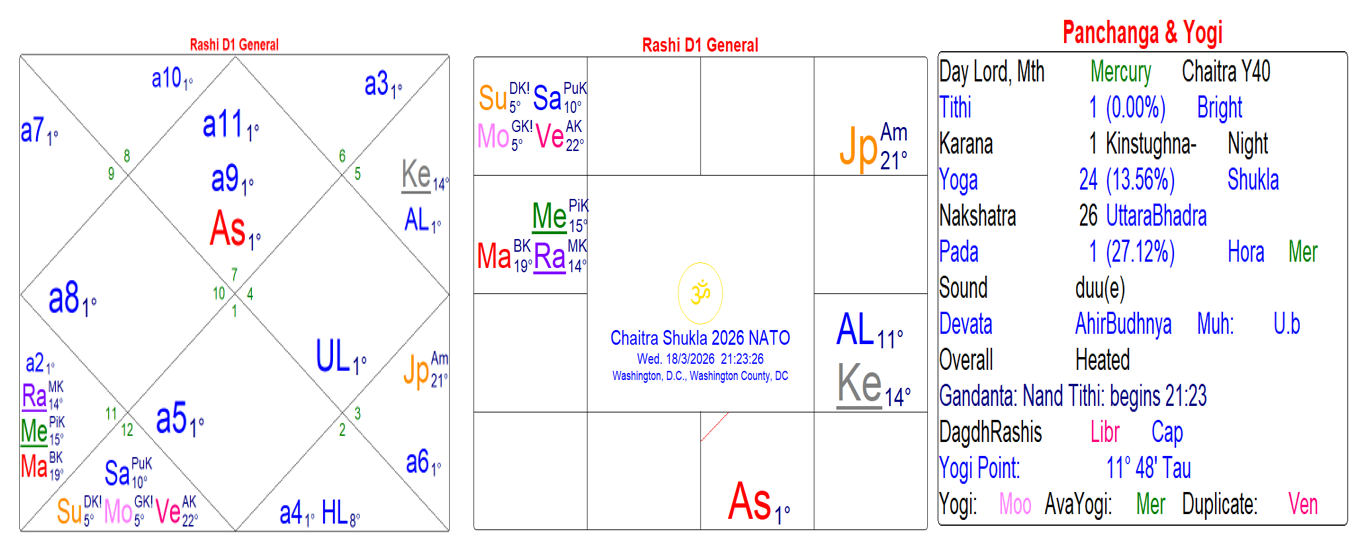
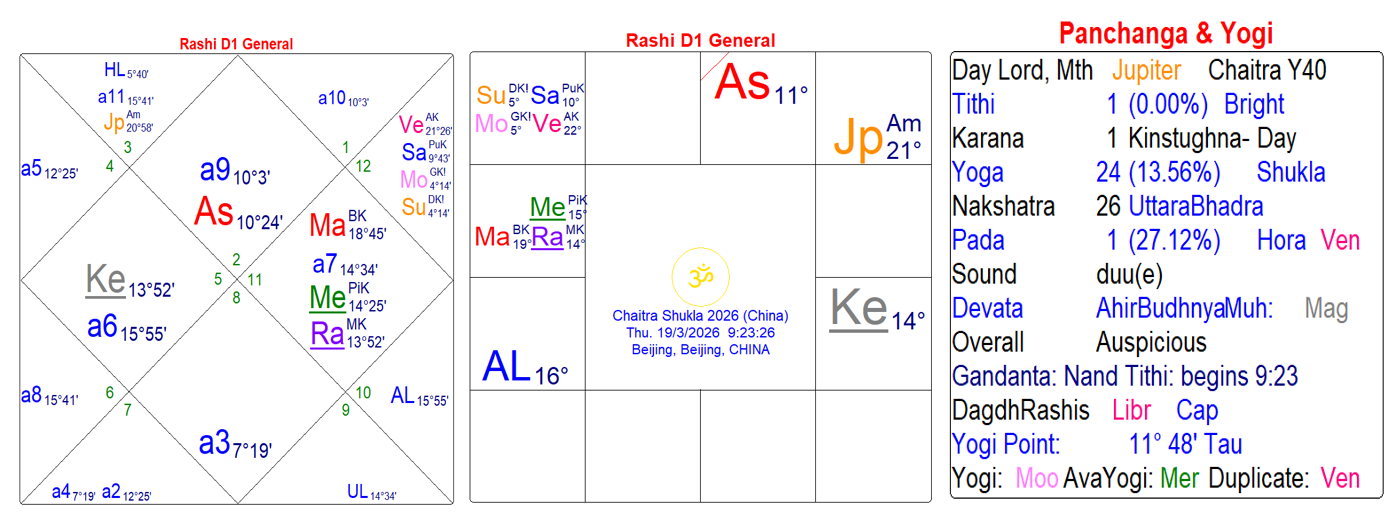
Chaitra Śukla Pratipada, the first lunar day following the New Moon in Pisces, marks the beginning of the lunar year known as Samvatsara and serves as the foundational chart from which the collective destiny of nations is assessed. The year is Parabhava, meaning “defeat” or “downfall,” concluding the eighth lustrum ruled by the Viśvadevas. Traditionally, it is associated with conflict, fire, weaponry, disease, sorrow, and heightened vulnerability among intellectuals, the marginalised, and livestock. Its symbolism aligns closely with the current global climate, characterised by war, geopolitical tension, trade disputes, strategic rivalry, and increasingly fragmented cooperation as the year begins on March 19.

As noted in the solar eclipse analysis, Rahu and Ketu transiting the Aquarius–Leo axis (May 2025–December 2026) intensify the tension between collective systems and individual authority. Ruled by Saturn and the Sun respectively—planets representing opposing principles of discipline and ego, structure and leadership—this axis reflects a struggle between institutional control and personal power. Rahu in Aquarius accelerates societal restructuring through political movements, ideological reform, and technological disruption, often producing gains through unconventional or crisis-driven channels. Consequently, capital has favoured sectors such as precious metals, technology, defence, and aerospace. Conversely, Ketu in Leo signifies detachment from status and centralised authority, frequently manifesting as weakened leadership, abrupt resignations, or the erosion of personality-driven regimes. Since mid-2025, several nations have experienced regime instability or political collapse, reflecting this broader theme of diminishing personal power.

Saturn’s transit through Pisces since March 2025 has slowed the healing and resolution normally associated with this sign. While Pisces seeks reconciliation, Saturn imposes delay, caution, and realism, prolonging negotiations and peace processes. Its combustion heightens public sensitivity and restraint, demanding accountability and practical reform over idealism. The concurrent presence of an exalted Venus provides a moderating influence, encouraging diplomacy, compassion, and humanitarian considerations that may soften otherwise severe outcomes.

At the same time, planetary concentration across three houses forms a Śūla Yoga, creating urgency, pressure, and decisive turning points. Jupiter’s aspect from Gemini supports dialogue and adaptability, while Venus with Saturn favours negotiated settlements. All planets lie between Rahu and Ketu, forming a Kāla Amṛta Yoga that compresses planetary energies and intensifies destiny-driven developments, often placing strain on governments and institutions and exposing structural weaknesses that demand reform.

Against this broader backdrop, the Chaitra Śukla charts of major powers and alliances illustrate how these collective pressures are likely to manifest at the national level. The principal themes are summarised below, with detailed analysis provided in the sections that follow.

The principal astrological configurations for each national chart are summarised below before the detailed interpretations.


Country / Entity Rising Sign Natal House Activated Ascendant Lord Placement Hora Lord Hora Lord Placement Key Themes
UK Sc 4th house – public, land, domestic governance Mars in 4th house

with Mercury

Su 5th house of power, creativity Domestic focus.  Governance and fiscal pressures dominate, producing political rivalry causing existential crisis with heavier reliance on taxation and debt restructuring. Healthcare and public systems face strain, though selective gains may arise through financial and speculative activity.
EU Sc 3rd house – agreement neighbours, alliances Mars in 4th house with Mercury influenced by Rahu Su 5th house of power, creativity Focus on bloc cohesion, negotiations, and alliance management. Expect change in leadership or objectives; gains may arise through regulatory enforcement, conflict-war, and restructuring and speculative activities.
USA Li 12th house – foreign affairs, expenditure, borders Venus in 6th house (Marana Karaka Sthana) Me 5th house of power and creativity External obligations, border concerns, and institutional vulnerabilities drive political aggression and volatility, bringing hidden liabilities. Leadership stabilises after early stress, while defence, aerospace, infrastructure and technology-linked sectors support financial resilience despite broader turbulence.
NATO Li 2nd house – funding, resources, member contributions Venus in 6th house with Saturn Me 5th house of power and creativity Financial sustainability and burden-sharing come under scrutiny, necessitating disciplined reorganisation and changes to funding structures and membership commitments. Leadership consolidates, but operational and coordination challenges persist.
China Ta 5th house – state power, reputation, strategy Venus exalted in 11th house with Sun and Saturn Ve 11th house Commercial conditions remain comparatively resilient with opportunities for gains, supported by fiscal strength, though legacy pressures from industrial overcapacity and real estate continue. Leadership remains strong, though challenges are likely to emerge with the shift of the Rahu–Ketu axis later in the year. Sporadic disruptions and border tensions may persist.


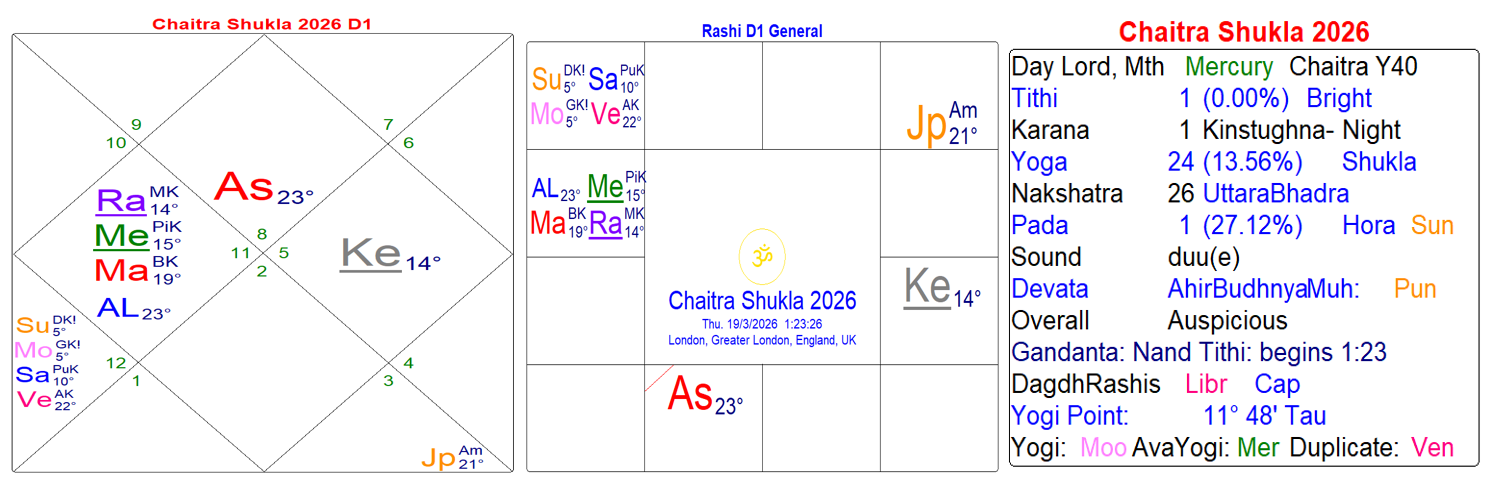
Chaitra Śukla  Pratipada for UK 2026-2027

The ascendant for London, United Kingdom, falls in the fixed sign of Scorpio, which represents the fourth house of happiness, the public, property, and agriculture in the nation’s natal chart. The ruler of Scorpio, Mars, is positioned in the fourth house along with Mercury, the lord of the day, placing emphasis on domestic affairs. The Sun, acting as the Hora Lord, brings the significance of  authority and governance into play. The combination of Mars and Mercury indicates intense political rivalry, likely taking place behind the scenes since both planets occupy the constellation of Shatabhisha. Rahu’s influence adds elements of hostility and misinformation. Rahu and Mercury, as lords of the eleventh house of gains, positioned in the fourth house, suggest a strong dependence on the public and taxation for revenue. However, due to retrograde movement, policies arising during this period may face challenges and require revision.

The presence of exalted Venus conjoined the Sun and Moon promotes diplomacy and cooperation in foreign affairs, consistent with its rulership over the seventh and twelfth houses. Saturn’s association, however, tempers this with caution and procedural discipline, suggesting that any rehabilitation or reform measures will be gradual, formal, and administratively controlled rather than swift.

The concentration of planets creates a pressured and reactive policy climate, with firm measures that may feel demanding for the public. Nevertheless, Jupiter’s aspect on the fourth house provides a degree of protection. Positioned as the ruler of the second and fifth houses and placed in the eighth, Jupiter indicates financial stability through an increase in creative debt management and speculative financial markets.

The recent solar eclipse peaking in the hour of Sun in February 2026 signalled an existential challenge for Prime Minister Keir Starmer and his cabinet, a strain that has become increasingly visible over the past six months. Analysis of the forthcoming eclipses further highlights vulnerabilities within healthcare systems, particularly the NHS, along with continued stress on broader business conditions.

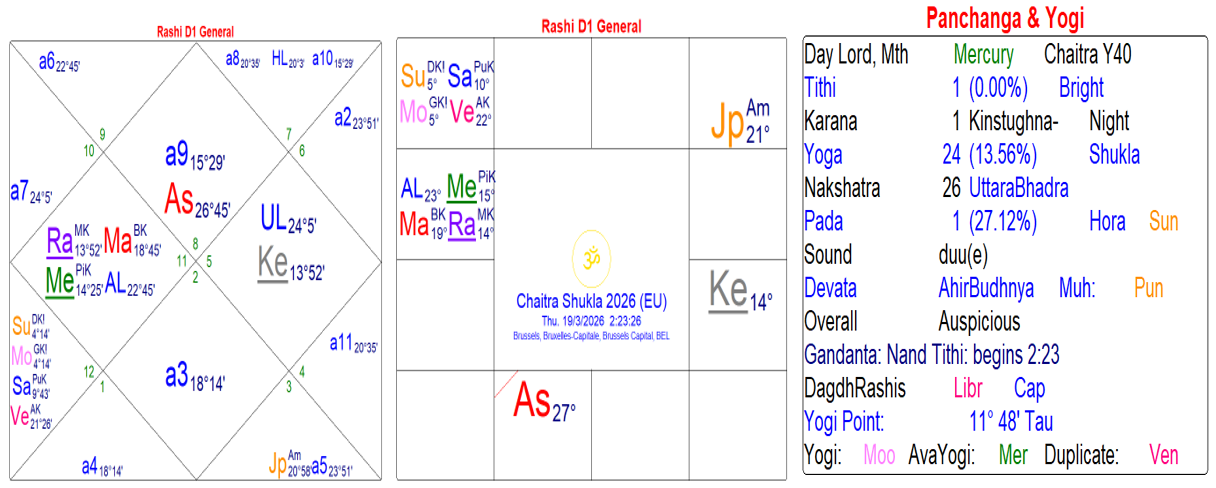
Chaitra Śukla  Pratipada for EU  2026-2027

The Chaitra Śukla chart for the EU rises in Scorpio, which corresponds to the third house of contracting, immediate neighbours and agreements in its natal horoscope. This places primary emphasis on consolidation, strategic partnerships, and the strengthening of bloc cohesion. Mars in the fourth house alongside Mercury, influenced by Rahu, indicates internal political competition, tactical manoeuvring, and episodes of misinformation and domestic dissatisfaction. With Aquarius governing the sixth house,  gains may arise through conflict or war, regulatory enforcement, or institutional restructuring.

The Hora Lord being Sun and placed in the 5th house of power brings authority and governance in to play.  Exalted Venus supports diplomacy and cooperation, while Saturn tempers progress with procedural caution, suggesting that reforms will be gradual and negotiated.  Jupiter’s aspect offers protection, favouring creative financial restructuring and speculative activities despite underlying pressures.

The February eclipse peaked in the hour of Sun signalling changes within leadership and the forthcoming one in August indicates issues with border areas.

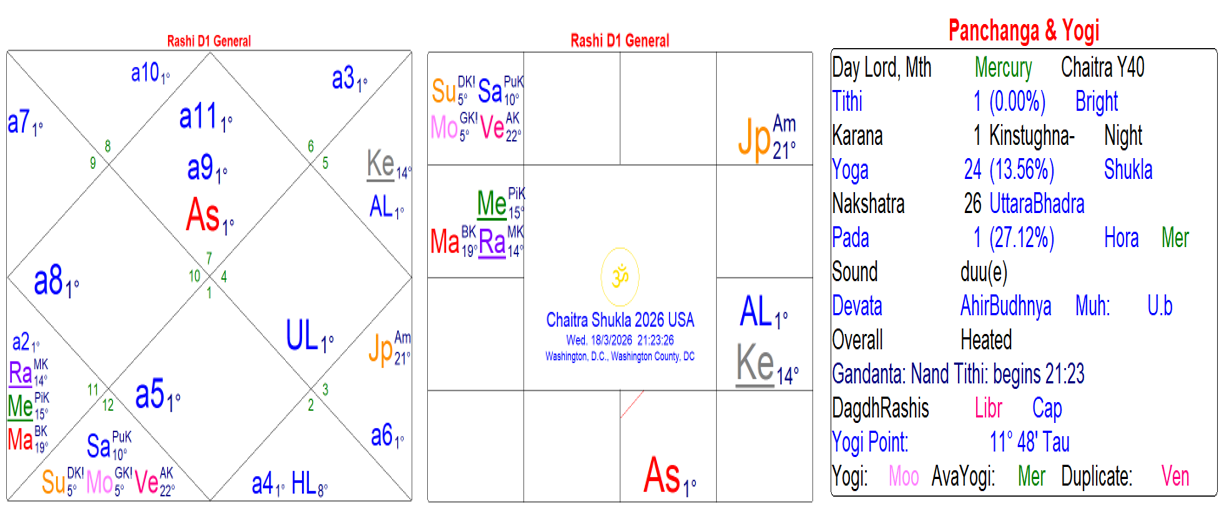
Chaitra Śukla  Pratipada for US 2026-2027

The ascendant falls in Libra, corresponding to the twelfth house of the natal chart, which governs expenditure, foreign relations, neighbouring nations, immigration, and border control. This immediately places emphasis on external obligations, fiscal outflows, and matters concerning national boundaries. The ascendant lord, Venus, occupies the sixth house in Marana Karaka Sthana, directing attention toward war, obstacles, and structural vulnerabilities within national institutions. Its condition indicates strain across administrative and social frameworks. Further affliction from Saturn and the Sun points to entrenched or legacy challenges, particularly in foreign and immigration policy, border management, and relations with other states.

Mercury, as both the day lord and Hora Lord assumes central importance for the year. Representing the head of state, Mercury is retrograde in Aquarius in the fifth house, conjoined Mars and Rahu. This configuration suggests heightened political competition, strategic manoeuvring, and repeated efforts to consolidate authority and manage alliances. The recent war in the middle east will result in huge liabilities for USA as Mercury rules over the 8th house.

Jupiter’s aspect to the fifth house provides a moderating influence, helping preserve financial stability despite turbulence. Mars, as second lord, placed favorably, supports gains through war,  engineering, infrastructure, logistics, and market-driven or speculative sectors, while Ketu’s position in the eleventh indicates windfall opportunities and wealth accumulation from technology and aerospace industries.

Overall, the chart favors decisive and assertive governance, often reactive and security-focused, suggesting a nation compelled to act boldly under pressure, particularly in matters of defense, enforcement, and strategic control.

The February solar eclipse marked a challenging phase for political leadership, as well as for judicial and academic institutions, while simultaneously strengthening defense and security sectors. Subsequent eclipses in August 2026 and February 2027 indicate an initial weakening of leadership followed by consolidation and recovery of authority, whereas military and defense advantages may gradually face operational or structural strain.

Chaitra Śukla  Pratipada for NATO 2026-2027

NATO operates under the same annual chart framework as the United States, as its place of incorporation is Washington, D.C. In this chart, the ascendant falls in Libra, corresponding to the second house of wealth, funding, and collective resources. This immediately directs attention toward questions of financial sustainability, shared contributions, and the cohesion of member states—specifically, who participates, at what cost, and under what obligations.

The ascendant lord, Venus, occupies the sixth house in Marana Karaka Sthana, indicating stress, disputes, and operational strain despite its exalted dignity. While Venus normally promotes cooperation and alliance-building, its placement in the house of conflict suggests that partnerships may be tested through disagreements over burden-sharing and strategic priorities. Venus is conjoined Saturn, lord of the fourth and fifth houses, further emphasising institutional pressure and responsibility. Together in the sixth, this combination points to structural strain within the alliance and the need for disciplined reorganisation. Additional affliction from the Sun highlights entrenched or legacy issues that could threaten cohesion if left unresolved. An exchange between the Sun and Ketu suggests shifts in funding patterns, with new financial sources or contributors emerging even as older ones diminish or withdraw.

Mercury, is both the day lord and the Hora lord  represents the leadership of NATO.  Mercury is retrograde in Aquarius in the fifth house and hemmed between Mars and Rahu. This indicates intense political manoeuvring, strategic competition, and complex negotiations, requiring deft management of alliances and repeated efforts to consolidate authority. Mercury’s rulership over the ninth and twelfth houses underscores themes of foreign relations, borders, and multinational cooperation, all of which demand careful handling. Again, Jupiter’s aspect provides some protection and stability.

The Śūla Yoga indicates NATO may be compelled to act decisively under stress, particularly in matters of security, defence coordination, and funding structures.

The solar eclipse in February signalled a strong period for Mars-related sectors such as defence and security forces. However, the subsequent eclipses indicate a weakening of  this position due to operational challenges  while leadership should strengthen.

Chaitra Śukla  Pratipada for China  2026-2027

The ascendant for Beijing falls in Taurus, corresponding to the fifth house of creativity, reputation, and state power in China’s natal chart. Its ruler, Venus, also serving as Hora lord, is exalted in the eleventh house of gains and opportunities, conjoined the fourth lord Sun and the ninth lord Saturn. This alignment, linking the ascendant lord with the lords of domestic stability and destiny in the house of gains, supports profitable ventures. However, the Sun–Saturn conjunction also highlights legacy or structural burdens, particularly within the real estate sector and long-standing over-capacity issues.

Jupiter, as day lord and dispositor of the eleventh house, represents those in positions of authority. Placed in the second house of treasury, it favours wealth accumulation and fiscal strength, though its rulership of the eighth also suggests reliance on debt, leverage, or external capital. Meanwhile, Mercury, Mars, and Rahu in the tenth house indicate intense competition, assertive policy execution, and strategic manoeuvring at the highest levels of governance. Jupiter’s aspect provides moderation and protection, helping maintain balance amid aggressive activity.

The February 2026 eclipse suggested that leadership could consolidate or emerge strengthened, though this advantage may be temporary. As eclipses shift to the Cancer–Capricorn axis, activating China’s natal 1/7 houses, pressure increases on both leadership and economic partnerships. The August 2026 eclipse points to sudden disruptions affecting business, legal, or judicial sectors while simultaneously strengthening the military and security apparatus. The February 2027 eclipse further signals potential leadership adjustments—possibly due to health concerns or internal strain—alongside renewed border tensions. Despite these challenges, commercial activity and broader economic performance are likely to remain comparatively resilient.

ॐ तत् सत्

This is the original analysis of Vijaya Jyoti, copyright © 2026 vijaya.jyoti.com. All rights reserved. No part of this article may be reproduced or transmitted without proper attribution to the author and source.

Eye on the Sky – Solar eclipses of 2026

The first eclipse to occur in Aquarius will take place in February 2026. Notably, although the nodal axis will be transiting Aquarius–Leo, the second solar eclipse of the year, in August 2026, will fall in the sign of Cancer, and there will be no solar eclipse in Leo during this cycle. The first solar eclipse of 2026 will be an annular eclipse (Ring of Fire) on 17 February 2026, occurring in Dhaniṣṭhā Nakṣatra  (4th pada) in Aquarius. This will be followed by a total solar eclipse on 12 August 2026, falling in Aśleṣā Nakṣatra  (3rd pada) in Cancer.

The Nodal Axis: Aquarius (Kumbha) – Leo (Siṁha)

A brief note on the nodal axis of Aquarius and Leo: these signs are ruled by Saturn and the Sun, respectively—planets that are diametrically opposed in the dig chakra and symbolise contrasting principles of authority, discipline, ego, leadership, and social order. As a result, this axis often coincides with heightened tensions between individual power and collective forces. With Rahu in Aquarius, there is an intensified drive to reshape society itself. This energy frequently challenges entrenched hierarchies and norms through political movements, ideological reform, and technological innovation. The recent rapid advancement and widespread acceptance of Artificial Intelligence exemplify this influence. During this period, gains often arise through non-traditional or foreign means, though such success may be accompanied by moral ambiguity, instability, or excessive fear and desire. That is why investments in gold, silver, technology, defence, and aerospace sectors appear particularly have been favoured under this influence.

By contrast, Ketu’s transit through Leo operates in a more inward and disruptive manner, often signifying loss, renunciation, or disinterest in power and recognition. This can manifest as sudden withdrawals from positions of authority or the collapse of ego-driven identities. Since May 2025, we have witnessed regime changes or political collapses in Iran, Venezuela, Myanmar, Nepal, Bangladesh, and Madagascar, reflecting this theme.

This aligns closely with the upcoming Samvatsara, spanning 19 March 2026 to 6 April 2027, known as Parābhava, meaning defeat, disgrace, contempt, or overthrow. Classical texts associate this year with afflictions arising from fire, weapons, disease, sorrow, and dangers particularly affecting intellectuals and cattle.

Solar Eclipse Type Time UTC/GMT Duration Sign Nakṣatra Degree Visibility Lunar Eclipse
17th Feb 2026 Annular 12.13.05 2m20s Aquarius Dhaniṣṭhā- 4th 4°37 Annular -Antarctica, partial -Parts of Southern America, Part of Southern Africa 2-3rd March
12th Aug 2026 Total 17.47.05 2m18s Cancer Aśleṣā – 3rd 25°55 Total -Arctic, Greenland, Iceland, Spain, Partial – Western Europe, W Africa, Europe 27-28 Aug

https://eclipse.gsfc.nasa.gov/SEdecade/SEdecade2021.html

Musings from 2025

There have been both hits and misses in my predictions from last year. Writing in 2024, I anticipated that the conjunction of Rahu and Saturn in Pūrva Bhādrapadā  would lead to widespread protests, wars, military actions, and the forceful suppression of civil movements. Indeed, we have seen regime changes in Syria, Iran, and Venezuela, alongside protests and civil unrest not only in developing nations but also within the United States.

However, some expectations remain unfulfilled. A temporary ceasefire or peace agreement between Ukraine and Russia has yet to materialise, and the anticipated regime change in Israel has not occurred. That said, an existential crisis for NATO, particularly with the Greenland issue at the forefront, has emerged broadly in line with my earlier assessment.

The United Kingdom continues to struggle with debt and financial pressures, while challenges to judicial authority persist in the United States, even as the country experiences significant financial prosperity—again aligning with earlier forecasts.

Predictions for 2026

Countries and individuals with ascendants along the Aquarius–Leo axis remain in the closing phase of nodal transformation through 6 December. The 1/7 axis typically forces decisive outcomes—alliances, leadership roles, and financial positions resolve rather than linger. As Varāhamihira notes, eclipses here tend to weaken rulers or strain state finances. With the UK’s progressed ascendant in Leo and the eclipse peaking near midday, pressures around debt, taxation, and executive leadership persist, keeping the government under sustained scrutiny.

The February annular eclipse in Aquarius, compressed between Mars and Saturn and tied to a difficult Jupiter–Rahu exchange, stresses trade, commerce, and institutional relationships. For the UK these manifests through partnerships and business, for the US through domestic security and internal cohesion, and for China through fiscal and monetary channels. Collectively, it signals tightening markets, commodity volatility, and ideological friction, producing credibility tests for leadership across the Anglosphere, inward fiscal focus in Europe, and firmer central consolidation in China—reform under constraint rather than expansion.

The August total eclipse in Cancer shifts the locus to borders, expenditure, food supply, and public welfare. Hemmed by Mars and Ketu, it suggests abrupt developments and strategic recalibration, particularly for defence alliances and security structures. Leadership is challenged particularly for US and NATO as the eclipse peaks at the hour of Sun, but may emerge leaner and more consolidated. UK continues fiscal and healthcare restructuring, China manages commercial realignment, and the EU emphasises stability. As the nodes enter the Capricorn–Cancer axis in December, attention correspondingly pivots toward states with those ascendants (China, Spain, Iran, France, and Germany), marking the next cycle of geopolitical emphasis.

Detailed country-specific effects are summarised in Tables 2 and 4 within the individual eclipse analyses.

Annular Solar Eclipse Feb 17, 2026 in Aquarius in Dhaniṣṭhā  

The ascendant calculated for the peak of the eclipse is Gemini has the presence of a retrograde Jupiter, which offers a degree of protection. The eclipse occurs in Aquarius, a sign also aspected by Jupiter; however, this mutual aspect between Jupiter and Rahu, the lord of the eclipse, is considered inauspicious. The presence of Venus and Mercury in the same house as the eclipse suggests  challenges for business and trade. Sectors related to commodities and agriculture are likely to experience difficulties. Aquarius, being hemmed between Saturn and Mars, carries oppressive  energy and, as the seventh house in the natal chart of the United Kingdom, indicates strain and unfavourable conditions for partnerships, commerce, and international relations.

Further examination shows that the eclipse reaches its peak around midday, an indication of strain for Prime Minister Keir Starmer and his cabinet. Nevertheless,  matters governed by Venus and Saturn are expected to produce some positive results, particularly benefiting women, healthcare, travel, low-income groups, the elderly, and border regions.

The eclipse falls on the 4th pada of Dhaniṣṭhā in the sign of Aquarius.  The Nakṣatra  Dhaniṣṭhā symbolises the prosperity and wealth and is presided by the deity Ashta vasus – ruling rhythm, and the elemental balance of nature  The 4th pada falls in the Scorpio navamsa, adding intensity, aggression, and a combative tone to the event’s expression. An eclipse in Aquarius considered unfavourable to mountain-dwelling people, the western direction, those involved in hard labour, thieves, herdsmen and barbarians. Eclipse is in the month of Phalguna is deemed adverse  for  noble woman, makers of weapons, rulers and hermits, dancer and crops.

I have tabulated the effect of the eclipse for some countries by casting a chart for the peak hour.

Table 2: Predictions based on the Solar Eclipse on Feb 17th 2026 in Aquarius
Country Eclipse Ascendant Eclipse Ascendant in Natal chart Eclipsed house Aquarius in Natal chart Suffering Planet Comments
UK Gemini 11th house 7th Sun Unfavourable for relationships, business  and diplomacy, challenges to PM and cabinet,
USA Aquarius 4th house 4th Ju/Me Domestic matters in focus with strife and dissatisfaction, unfavourable for Trump but more so for judiciary and intellectual institutions
China Virgo 9th house 2nd Ve Challenges with respect to travel, hospitality and women, Cabinet is challenged but leadership emerges stronger
EU Gemini 4th house 6th Su Focus on domestic matters and financing and challenges to leadership but may emerge victorious
Nato Aquarius 6th house 6th Ju/Me Operational challenges, leadership will over- come conflict


For individuals, if the natal Sun, Moon or Ascendant is placed in Dhaniṣṭhā, it may be a time to increase awareness about finances, health and direction in life. The impact of the eclipse is felt roughly six months before or after the eclipse. Table 3 lists some key personalities that have their Ascendants, Sun or Moon in Dhaniṣṭhā

Table 3 : Statesmen/ Celebrities with Ascendants or Sun and Moon in Dhaniṣṭhā In Aquarius
Ascendant in Dhaniṣṭhā Sun in Dhaniṣṭhā Moon in Dhaniṣṭhā
Amitabh Bacchan John McEnroe Jair Bolsonaro
Mark Rutte King Jean Carlos 1
Mike Bloomberg Victoria Beckham
Paris Hilton Woody Allen
Swami Niranjan Saraswati


Total Solar Eclipse – 12th August 2026  in Cancer in Aśleṣā

The ascendant at the time of the eclipse is Sagittarius, which represents the fifth house of reputation and creativity in the United Kingdom’s natal chart. Its ruler, Jupiter, is positioned in the eclipsed house Cancer with Mercury, the lord of the seventh house governing business and partnerships. This alignment is unfavourable for both the general public and commercial activity.

The eclipse occurs in Cancer, corresponding to the twelfth house of expenditure, which is also associated with border regions and neighbouring countries. The eclipsed house is flanked by Mars and Ketu, a configuration that can bring sudden disturbances or tensions along the borders. The planetary positions form a garland pattern, enclosed between Mars and Venus, a combination known to heighten emotional intensity and instability. Both Saturn and Mars aspect the ascendant, reinforcing the theme of disturbances.

The eclipse peaks in the hour of Venus, therefore women, health care  hospitality and travel will have negative effect. NHS may see a huge transition. Working class will benefit.

This is a total solar eclipse in Cancer, occurring in the 3rd pada of Aśleṣā Nakṣatra . Eclipses in Cancer are traditionally adverse for agriculture and food supplies – grain and cattle (milk-producing animals) and also fisherman & sailors and those in nurturing professions like healthcare, while those occurring in the lunar month of Shravana are considered harmful to autumnal crops (barley, rye, wheat) and forest-dwelling or hunting communities. Aśleṣā Nakṣatra , ruled by serpents (Nagas), carries an energy of secrecy, depth, and mastery over poisons—a symbolism that can manifest as both healing and manipulation. The 3rd pada, falling in the Aquarius Navamsa, enhances strategic intelligence and hidden manoeuvring, suggesting a period marked by covert negotiations and , behind-the-scenes activity.

Table 4 : Predictions based on the Solar Eclipse on August 12th 2026
Country


Eclipse Ascendant Eclipse Ascendant in Natal chart Eclipsed house Cancer in Natal chart Suffering Planet Comments
UK Sagittarius 5th house 12th house Ve Sudden disturbances likely, unfavourable for hospitality and healthcare
USA Libra 12th house 9th house Su Challenges to leadership, but gains to security and defence
China Gemini 6th house 7th house Ju Potential disruptions in relationships or business, defence and technology areas to prosper, academia and intellectual pursuits to suffer
EU Sagittarius 4th house 11th house Sa Focus on domestic issues, financial stability and alliances and gains, border areas will struggle
NATO Libra 2nd house 11th house Su Re-writing membership and securing funding, leadership will be challenged


If the natal Sun, Moon or Ascendant is placed in Aśleṣā  may be a time to increase awareness about finances, health and direction in life. The impact of the eclipse is felt roughly six months before or after the eclipse. Table 5 lists some key personalities that have their Ascendants, Sun or Moon in Ashelsha

Table 5 : Statesman/ Celebrities with Ascendant, Sun or Moon in Aśleṣā
Ascendant in Aśleṣā  Sun in Aśleṣā Moon in Aśleṣā 
Catherine, Princess of Wales Barack Obama Ghislaine Maxwell
Richard Branson Marine Le Pen Nicolas Sarkozy
Novak Djokovic Roger Federer Volodymyr Zelenskyy
Sonia Gandhi Meghan, Duchess of Sussex Paul McCartney
Iran Gordon Brown
Mauritius


Remedies

The Solar energy or Agni (Fire element) gets weakened in an eclipse. Agni or precisely jātargni aids in digestion, therefore one should observe fasting at the time of the eclipse as the digestive process will be weak. After the eclipse, bathing is prescribed invoking the devas and loka-palas beckoning the seas and rivers to wash of the digressions to remove the suffering caused by inauspicious planets. This bathing is more essential if the Sun, Moon or the Ascendant is in the eclipsed sign and in the Nakṣatra  of Dhaniṣṭhā or Aśleṣā.

From the tradition I have been taught, seekers and those affected are asked to worship Jupiter or Shiva who is the “Father of the Universe” to reduce bad energy and restore the glory of Sun. We recommend praying to the teaching form of Shiva called Dakṣiṇāmūrti with mantra

ॐ दक्षिणामूर्ति रतरोम्

om dakṣiṇāmūrti ratarom

or

ॐ नमो भगवते दक्षिणामुर्तये मह्यं मेदां प्रज्ञां प्रयच्छ स्वाहा

om namo bhagavate dakṣiṇāmurtaye mahyaṁ medāṁ prajñāṁ prayaccha svāhā

Giving to charity on this day is also highly encouraged.

References

  • Based on the principles taught by Jyotish Guru Pandit Sanjay Rath
  • Bṛhat Samhitā – Varahamihīrā, M. Ramakṛishna Bhat, Part 1, Motilal Banarasidass Publishers Pvt. Ltd, Delhi, India
  • Eclipse Data from https://eclipse.gsfc.nasa.gov/solar.html
  • Time and Date.com Solar & Lunar Eclipses Worldwide (timeanddate.com)
  • Shri Jyoti Star – Vedic software

ॐ तत् सत्


This is the original work of Vijaya Jyoti, copyright © 2026 vijaya.jyoti.com. All rights reserved. No part of this article may be reproduced or transmitted without proper attribution to the author and source.