
The conjunction of Jupiter and Ketu is traditionally associated with spiritual awakening, detachment and the pursuit of higher knowledge. Jupiter represents wisdom, dharma, prosperity and the principles that sustain society, while Ketu is associated with mokṣa and renunciation.
Yet the conjunction does not invariably produce spiritual upliftment or favourable material results. Much depends on Jupiter’s dignity, the influence of other planets, the nakṣatra and, importantly, the manner in which the planets meet. A head-on encounter may bring severe disruption, while separation may be materially favourable. When retrograde Jupiter approaches Ketu from behind, judgement and discernment may become clouded, with the risk of losing independence of thought.
Two classical principles are relevant here. The Bṛhat Parāśara Horā Śāstra (37.16) describes how the nodes absorb and amplify the nature of planets they conjoin, while the Jātaka Pārijāta (6.6) draws attention to the breakdown in moral framework when Jupiter is in debilitation or afflicted and associates with a debilitated planet.
Between November 2026 and April 2027, Jupiter and Ketu meet three times, first in Maghā in Leo and subsequently twice in Āśleṣā in Cancer. Mars is an important modifying influence throughout this period. Its conjunctions with Ketu and Jupiter in Leo intensify the exercise of leadership and executive power, in contrast to its later debilitation in Cancer.
The closest historical parallel examined is 1932–33, when Jupiter, Ketu and Mars were also involved in Leo, during a period of significant changes in political authority and financial control.
The Four Movements of Transit
Ketu moves retrograde through the zodiac, while Jupiter periodically changes direction. Their relative movements therefore create different forms of conjunction and separation. The following illustration applies the principles of Saṃyoga taught by Pandit Sanjay Rath to this Jupiter-Ketu conjunction.
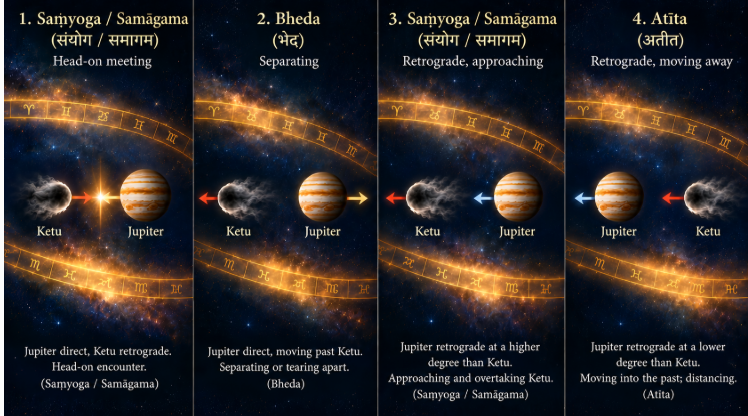
The table below breaks down my interpretation on exactly how these four movements will play out across the upcoming 2026–2027 encounters.
| Jupiter – Ketu Conjunction Time Line November 2026 to June 2027 | ||
| Period | Movement | Effect |
| 31 Oct – 11 Nov 2026
(Exact Conjunction: 1° 18′ Leo- Maghā ) |
Saṃyoga – Head on collision | Sudden volatile developments; maximum intensity with friction unavoidable structural shifts or realignment of political alliance sudden closures of legal or financial matters |
| 11 Nov – 13 Dec 2026*(1) | Bheda – Separating | Drifting apart, temporary breaking free from obstacles, unobstructed material and intellectual expansion |
| 13 Dec 2026 – 1 Mar 2027** (2)
Exact Conjunction: JP Rx 25°27′ Cancer – Āśleṣā ) |
Saṃyoga – retrograde approaching | Reopening unresolved matters; Halting forward momentum entirely. Re-audit of beliefs and re-evaluation of wealth or projects, collective logic can buckle under narcissistic leadership |
| 1 Mar – 13 Apr 2027 | Atīta – retrograde moving away | Revisiting the past; internal processing, repetition, dealing with deeply buried unfinished business autonomously. Creates a window for massive whistleblowing operations and leaks of classified institutional secrets and forensic audits |
| 13–20 Apr 2027***(3)
Exact Conjunction: JP St 22°50′ Cancer – Āśleṣā ) |
Saṃyoga – Head on collision | Absolute settlement and systemic realignment. capitulation, total cessation of resistance, allowing for binding agreement, structural treaty, or financial settlement to be smoothly executed. |
| 20 Apr – 26 Jun 2027 | Bheda – Separating | Separation; karmic debt paid, resolution and forward movement, materially good |
| *(1)Jupiter in Leo and Ketu in Cancer from 6 Dec 2026-25 Jan 2027; Jupiter turns retrograde on 13 Dec 2026 | ||
| **(2) Jupiter crossing gandanta from Leo and moving back to Cancer on 25th Jan 2027 | ||
| ***(3) Jupiter is stationary in the conjunction as it turns turns direct 13 Apr 2027 | ||
Three Encounters, Three Different Conditions
The three Jupiter–Ketu conjunctions suggest a progression from open confrontation to the exposure of underlying problems, followed by an attempt at resolution or restructuring.
November 2026 is potentially the most explosive period, with a head-on Saṃyoga in Maghā, followed by Mars conjoining Ketu on 16 November and Jupiter on 19 November in Leo. Mars also casts its eighth aspect on Saturn in Pisces, adding tension between executive action and established institutional structures. This could precipitate sudden changes in political leadership, alliances, institutional authority or financial arrangements. Maghā’s Tyāga Śakti, the power of relinquishment, adds the possibility of surrendering authority, privileges or established positions.
March 2027 presents a different situation. Jupiter approaches Ketu in retrograde motion in Āśleṣā, while debilitated Mars returns to Cancer. Rather than an entirely new crisis, this period may expose the deeper consequences of earlier developments. Unresolved disputes, concealed weaknesses and financial or institutional irregularities may resurface, leading to obstruction, investigation and the unravelling of existing arrangements. Āśleṣā’s Viśleṣaṇa Śakti, the power of separation or disentanglement, reinforces this possibility.
April 2027 brings the final encounter in Āśleṣā after Jupiter and Mars have resumed direct motion. Jupiter is exalted in Cancer, while Mars remains debilitated and in the background. This suggests a difficult but potentially decisive settlement or structural realignment, perhaps requiring significant concessions rather than a restoration of the previous order. The subsequent separation of Jupiter and Ketu after 20 April may permit renewed forward movement.
Historical Precedents: The Importance of Planetary Context
Historical Jupiter–Ketu conjunctions provide an opportunity to examine how similar planetary configurations have accompanied major political and economic developments. The periods of 1932–33 and 1990–91 are particularly interesting because both involved Leo and Cancer, yet produced very different outcomes. The former witnessed the concentration of political power and restrictions on financial freedom, while the latter saw the dissolution of established political structures and greater economic integration.
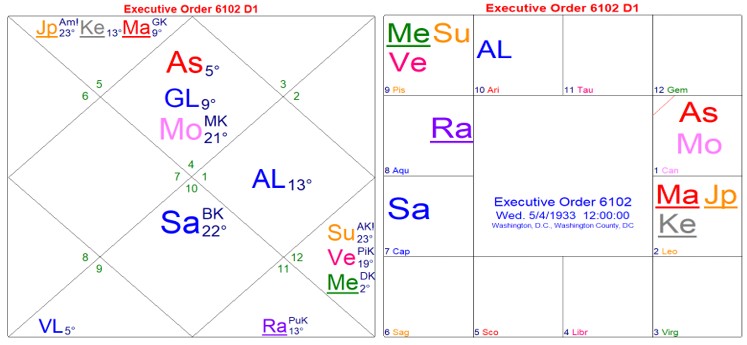
The early 1930s were marked by the Great Depression, the rise of authoritarian movements and unprecedented government intervention in financial affairs. In April 1933, the United States issued Executive Order 6102, requiring citizens to surrender most privately held monetary gold under threat of legal penalties.
On that day, Jupiter, Mars and Ketu were all retrograde. Jupiter and Ketu were in Atīta, a period of separation and reconsideration, while retrograde Mars approached Ketu from behind in Saṃyoga. This combination suggests a weakening of collective resistance in the face of strong executive authority. Mars and Ketu were in Maghā, whose Tyāga Śakti signifies relinquishment or sacrifice. The compulsory surrender of gold offers a striking expression of this symbolism. The exchange between the Sun and Jupiter further connects executive authority with wealth and the extraordinary government intervention represented by Executive Order 6102. The Moon in Āśleṣā suggests collective paralysis in the face of executive action.
During the same period, Adolf Hitler was consolidating his authority and dismantling the institutions of the Weimar Republic. The parallels with 2026–27 are therefore particularly relevant to questions of executive power, financial control and the influence of Mars.
The period around 1990 presents a contrasting picture. Germany was reunified, Soviet authority weakened, and political and economic relationships across Europe were transformed. At the time of reunification on the 3rd October 1990, Jupiter was exalted in Cancer and occupying Puṣya, whose śakti is associated with nourishment and growth. Jupiter was moving ahead of Ketu in Bheda, the separating phase. This movement suggests release from karmic debt and constraints and the possibility of material progress. The move of Saturn in Capricorn towards the end of that year provided a further influence of discipline and structural reorganisation. The eventual dissolution of the Soviet Union and the subsequent economic integration of formerly separated countries illustrate a different expression of the Jupiter–Ketu cycle.