
Samādhāna – Absorption


Guru Pūrṇimā is a special day in the life of spiritual seekers as we express gratitude to our Acharyas and Guru for teaching  and sharing knowledge and wisdom. It falls on the full moon day usually when the Sun is in Gemini and Moon is in Sagittarius in the sidereal calendar in the lunar month of Āṣāḍha.

6 years ago, on this same occasion I started writing on the topic of the importance of practising  “Sādhanacatuṣṭaya” or the four-fold qualification prescribed for students that facilitates para vidya – spiritual learning. https://vijayajyoti.com/guru-purnima/. Being aware of these requirements is a preliminary step in the path of spiritual progress. The more qualifications we gain, the better will be the assimilation of knowledge and the in the practice of it. When there is a conflict in theory and practice, then it is advised that one must re-visit these qualifications to see what is being not followed.

While it is said that three qualities of the four – Viveka (discrimination between the real and unreal), Vairāgya (spirit of renunciation)  and Mumukṣutva (deep desire to be liberated)  may actually cause obstacles in the path of a material and mundane life with attachments; the fourth one, śaṭ sampatti – the six-fold qualification or discipline (Śama, dama, titiksha, uprati, Śraddhā and samādhāna) is very helpful even to succeed in daily life. This article explores last of the six  – the quality of  Samādhāna – absorption as my offering for the day.


What is samādhāna and why is it important?

The literal meaning of samādhāna is concentration or absorption from words  “sam” – which means together, entirely, wholly, perfectly, absolutely, or thoroughly and “ādhāna” – is placing receiving or putting. At the more basic level, it involves directing the intellect to be focused on the objective after consciously relieving oneself from all distractions of a wandering mind earlier described by the practice of śama (equanimity) https://vijayajyoti.com/guru-purnima-2/ and dama (austerity in the use of senses) https://vijayajyoti.com/dama-austerity-in-use-of-the-senses/.

Tattva Bodha, an introductory text of Vedanta written by Adi Śaṅkarācārya defines Samādhāna in Verse 6.1  as “chitta-ekagratha”, the one-pointedness of the mind that is needed for any pursuit whether material or spiritual.

Single pointedness is the ability to have the goal in one’s sights. A successful bowman has to have his eye only for the target. To recount a story from the epic Mahābhārata, Droṇācārya the royal preceptor wanted to test his students the Kaurava and Pāṇḍavā princes under his tutelage. He placed a wooden bird on top of a high tree and asked each of his students to take aim at its eye. As the princes came forward to shoot, he asked each of them what they saw. The responses varied as some described the bird, the surrounding trees and sky. Disappointed,  he asked them to step back.  Only Arjuna his favourite student with an unwavering focus on the object and the goal replied  “I see only the eye of the bird.” He was allowed to shoot and declared the winner.

Knowing how to focus and concentrate all our efforts on a single task, goal or process can be life-changing. The common saying is where you place your attention is where your energy goes – “Neurons that fire together, wire together”. Modern Neuroscience offers a scientific lens to examine the spiritual practices of the Upanishad and Yoga sutras. The nervous system is made up of individual, discrete nerve cells, not a continuous network and when a neural pathway is used repeatedly, the connection between neurons strengthens, making it easier for signals to travel along that pathway allowing the brain to re-wire itself with new information, knowledge, skill and habits.

Śrī Kṛṣṇa too in Bhagavadgītā praises the steady intellect of a spiritual aspirant over the ones that have dissipated minds are multi-tasking involved in multifarious activities in the world.

व्यवसायात्मिका बुद्धिरेकेह कुरुनन्दन |

बहुशाखा ह्यनन्ताश्च बुद्धयोऽव्यवसायिनाम् || 41||

O descendent of the Kurus, the intellect of those who are on this path is resolute, and their aim is one-pointed. But the intellect of those who are irresolute is many-branched.

For those whose goal is liberation, the advanced Vedanta texts such as Viveka Cūḍāmaṇī  describe Samādhāna as the consistently directing the intellect towards the ultimate encompassing reality –  the Brahman with steadfastness and detachment from the mind’s vagaries.

सर्वदा स्थापनं बुद्धेः शुद्धे ब्रह्मणि सर्वदा ।
तत्समाधानमित्युक् चित्तस्य लालनम् ॥ २६ ॥

Always establish the intellect in pure Brahman, that is called Samādhāna (meditative absorption), not the pampering of the mind.

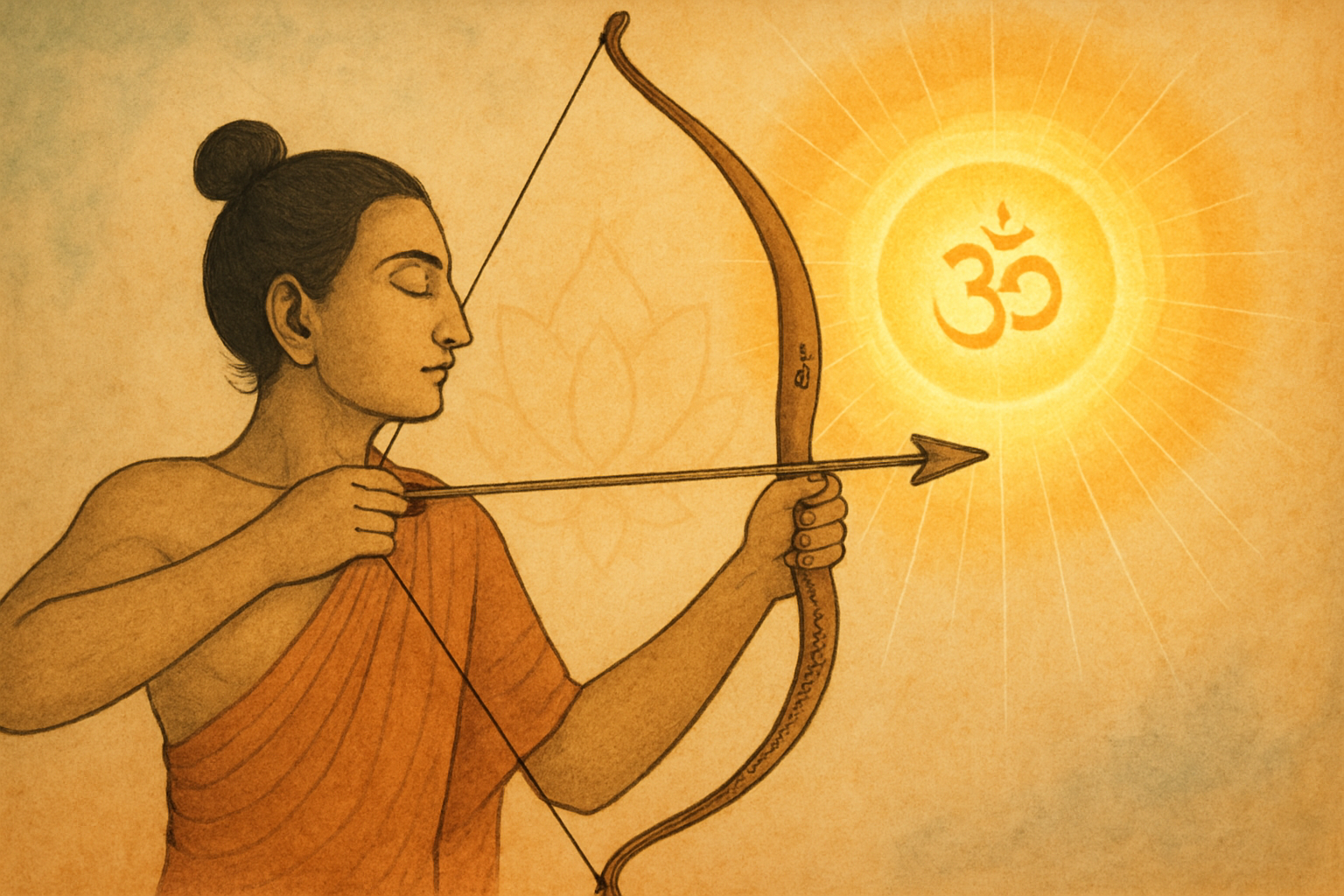
The Muṇḍakopaniṣad also uses the metaphor of archery to illustrate the spiritual pursuit. The seeker is instructed to arm themselves with the bow – the knowledge of the Upaniṣads. The arrow is the seeker himself  who has been sharpened by absorption of  the knowledge while constantly directing his intellect to be focused on Brahman, must aim to strike, and when he does will be inseparable from Brahman like the arrow with its target when hit.

प्रणवो धनुः शारो ह्यात्मा ब्रह्म तल्लक्ष्यमुच्यते ।

अप्रमत्तेन वेद्धव्यं शरवत्तन्मयो भवेत् ॥ ४ ॥

The Pranava is the bow, the Atman is the arrow and the Brahman is said to be its mark. It should he hit by one who is self-collected and that which hits becomes, like the arrow, one with the mark, i.e.. Brahman.

Sage Pātānjali  in his yoga sutras (Verses 3.12 and 3.13) introduced another subtle point in the discussion. He described one-pointedness as one of the five states of mind and advocated that one has to raise awareness and maintain the one-pointedness or stillness of the mind that emerges between rising and falling thoughts in meditation.

From the philosophy of Vedanta that prescribes the path of Jñāna yoga, the practice of samādhāna includes the long terms goal of commitment and staying on the path and simultaneously following the short-term process of assimilation and absorption of the knowledge while listening to the scriptural texts. One should be able to categorise the topic appropriately while assimilating during the process of  Śravaṇa. Here, it may be necessary to distinguish the difference between  Śraddhā https://vijayajyoti.com/sraddha-faith-or-confidence/  which also involves staying on the path with unwavering alertness and samādhāna which involves making the mind stable while being absorbed with knowledge.

The prakaraṇagrantha  text  Sarva Vedānta  Siddantha Sāra Sangrah written by Adi Shankaracharya describes the importance of samādhāna during the process of  “Śravaṇa” – listening to the Vedantic texts.

श्रुत्युक्तार्थावगाहाय विदुषा ज्ञेयवस्तुनि।

चित्तस्य सम्यगाधानं समाधानमितीर्यते।।२१८

One should dive deep into what the Śruti says. One should be completely absorbed in it, in order to attain the knowledge of the ultimate Reality. It is such total absorption that is called concentration.

Thus, the focused mind endowed with knowledge from Śravaṇa allows for deep contemplation and introspection, making it a powerful tool for self-realization and spiritual growth. At the very highest level from the point of Vedanta, the samādhāna of a jñānī is the total absorption of mind equalling samādhi, nevertheless still a tool getting him closer to ultimate realisation.

Obstacles to Samādhāna

Samādhāna is not only dedication and commitment to any goal but the process  allows for absorption of the knowledge so that it becomes continuous and spontaneous. The nature of mind is that it continuously expands and wanders to satisfy its curiosity in the manifold external objects that are available to us. I find difficult to recall last time I read something without needing to go back to reread the contents. For those who watch TV, when was the last time you watched something on the TV or computer without needing to look at your phone?  Similarly, very few of us are really aware of where our mind is travelling while we are listening. The  modern-day skill of multi-tasking and also endless distractions of social media leads to scattering and dissipation of the mind.

The brain has the ability to reorganize itself by forming new neural connections throughout life. Modern day requirement of multitasking, while often perceived as efficient, can negatively impact neuroplasticity. When constantly switching between tasks the brain strengthens neural pathways associated with switching and distraction and superficial thinking and make it harder to focus on one task for extended periods.  It has been found that a brain rewired for multi-tasking makes memory poor.

Further, there is a gap between the knowledge that we hear/learn and our practice as we are often limited by our inherent tendencies (vāsana) that we are born with that which colours our narrative of life. Led by the vāsana, we employ defence patterns (such as denial, repression, displacement and projection) to enact our script and support our agenda which creates blocks in realising any goal.

Without a steady mind capable of sustained reflection upon the teaching, self-knowledge will remain nothing but an abstract concept. The committed seeker has single-pointedness of mind and a clear goal in sight.

Essential conditions  for Samādhāna

An essential condition for  samādhāna is paying attention to the quality of listening. Deep and focused listening or Śravaṇa is the first step in learning and assimilation of any knowledge. The quality of the presence of mind, directly affects the quality of listening and the quality of absorption. That is why these days corporate organisations invest in coaching their executives and star performers in the art of listening and to being completely present while being aware thoughts and efficiently separating their observation from judgement.

Further, we always focus, commit and give energy to what we value, appreciate and are devoted to.  That is why in many traditions a pleasing visual object or a word is used to start in the initial process of focussing or meditation.  This later leads to for a spiritual seeker into the path saguna Ishwara dhyana- meditation of a deity of our choice  before settling into the path of Nirguna formless Brahman.

To conclude,  when there is Samādhāna, the mind is steady and stable in an absorbed state as an unflickering lamp attached to the highest path.

यथा दीपो निवातस्थो नेङ्गते सोपमा स्मृता |

योगिनो यतचित्तस्य युञ्जतो योगमात्मन: ||BG 6.19||

Just as a lamp in a windless place does not flicker, so the disciplined mind of a yogi remains steady in meditation on the Supreme.

ॐ तत् सत्

References

  1. Svāmi Paramārthānanda’s teachings on Tattva Bodha, Bhagavad Gītā , Muṇḍakopaniṣad,  Viveka Cūḍāmaṇī, and Sarva Vedānta  Siddantha Sāra Sangrah
  2. Light on the Yoga sutras of Pātānjali by BKS Iyengar
  3. The Holy Gīta – Commentary by Swami Chinmayanada
  4. The Brain That Changes Itself by Norman Doidge

Eye on the Sky – Chaitra Śukla Pratipada 2025

The chaitra śukla pratipada  is the first lunar day after the New Moon in Pisces from which chart the destiny of countries for the upcoming year is read. This is starting point for a new year called Samvatsara. The chaitra śukla pratipada for 2025 coincides with the Solar eclipse again like in the previous year which is not fortunate . However, this time we are entering a benign samvatsara of  Viśvāvasu that means “wealth of all” or “the beneficent one” leaving behind  the difficult year of krodhi (meaning anger)

The Chaitra śukla  on March 29th comes at a time when the leaders of the world are huddling together to meet and have intense negotiations about bringing the end of war while thinking how to benefit their own countries. This is symbolised by 6 planets in Pisces and the other three connected by exchange or aspect. Moreover, there will be a sarpa yoga (malefics in 3 quadrants) for dual signs which will make the events harsh and binding. Saturn’s the planet that doles out karma will  transit into Pisces the same day, not only make the sarpa yoga stronger but also result in hemming the planets between the nodes (creating a kala amrita yoga) in the sky.  The release from this can  only happen after 28th July when Mars will move out of Leo and Ketu’s influence. This is when we can expect to see some concrete steps to implement ceasefire, even as they may be temporary.

While the chaitra śukla  is on Saturday, the celebration  of the new year – Ugadi is the next day,  Sunday in India and the UK whereas it is on the same day in the USA. The lord of the day or Vareśa will be Saturn as it is in the last degrees of Aquarius and in the process of slipping into Pisces, hence not very stable. Vareśa represents the King and the Heads of the State in every horoscope, therefore the need of the hour for these statesmen is to be nimble or it can be read that they may also change positions in the last minute.

The Sun and Moon are in Uttarabhādrapadā in Pisces and this provides an opportunity for a deep-awakening after intense suffering. Mars is in Gemini and vargottama, however it is with Saturn in the navāṃśa forming a yama yoga of destruction. Thus, Gemini should be the point of suffering and transformation for each of the countries. For UK this will be monetary gains and relationships, For US it be debts, for China it’s enemies and its own weaknesses, for Israel it is destiny and philosophy, for Russia it power and governance and Ukraine it is war, relationships  and business.

I have analysed below the Chaitra śukla  charts for UK, USA, China, Israel, Russia and Ukraine. I have also included the analyses of the solar eclipses and their natal charts to arrive at a proper judgement.

Chaitra Śukla  Pratipada for UK

The Ascendant is Gemini and in the benign Punarvasu nakṣatra  which means beginning of new light, so we can expect progress this year. Gemini is the 11th house of gains and friendship as the natal progressed ascendant (1801) for the UK is Leo. Mercury representing the UK is combust and debilitated but retrograde, so we will be trying very hard not be giving up. PM Starmer may be feeling threatened with 6L Mars in the ascendant but as Mars is also the 11L, UK will be trying to  get some monetary gains and re-establish connections from world events by getting a larger role in keeping up with defences. The importance of relationships is key at present as UK is running the māhā daśā of Libra and antara of Gemini. The challenge from US (indicated usually be Gemini) is visible as Venus is placed in the 7th house of Aquarius aspected by Rahu and Saturn from Gemini in the 11th house.

The 5 planets in the 10th house shows some intense negotiations with matters of governance and administration. The 3L Sun with directional strength dealing with matters of strategy and defence regarding immediate neighbours (read EU, Ukraine) is being eclipsed and the presence of Rahu shows manipulation and influence by vested interests. The 7L Jupiter representing interest of defence and war strategy of the UK in the 12th shows  increase in expense. Jupiter’s  exchange with 2L and 5L Venus (representing economic interests of healthcare, retail and travel) shows that defence matters will take precedence over the normal needs of the country. As Mercury is also 4L, UK will be looking to align with neighbouring countries in food and agricultural matters.

The presence malefic planets are in 3 quadrants – Sarpa yoga and kala amrita yoga with Saturn’s move into Pisces will  make the events binding events. The presence of benefics Venus and Mercury cannot mitigate the harsh effects as they are combust and retrograde.  We can expect some clarity after 28th July when Mars will move out of Leo.

The solar eclipse analysis confirms that business matters will remain weak in the UK with unexpected gains (8th house effects) and the general public will suffer.

Chaitra Śukla  Pratipada for EU

The Chaitra śukla  chart for EU is also Gemini with the same nakṣatra of Punarvasu and in the same pada. We can expect similar intensity in negotiations with defence strategy coming to the forefront. However,  the navāṃśa for EU is vargottama in Gemini with Mars (AMK) also vargottama indicating that Europe may want to take the lead in peace keeping and defence and are ideally looking for longer term solutions for the area. The combustion and retrogradation of Mercury indicates that the task will difficult and will need at least 3 attempts to complete.  For both Germany and France with natal ascendants are Cancer, Gemini is the 12th house showing the focus as expenses on strengthening borders. EU countries will have to step up defence spending with increasing reluctance of USA to beef up NATO.  EU will be running the māhā daśā of  Gemini until November 2027 which is the 12th house from the natal chart of EU, therefore we should expect them to remain embroiled with the borders and defence matters  until then.

Chaitra Śukla  for USA

The ascendant is in Pisces  in the nakṣatra of Uttarabhādrapadā, same as the eclipse, there should be victory in the end but not without suffering first. Pisces is the 5th house of power the progressed natal chart of USA(1776). Matters regarding defence and strategy of the neighbouring countries say, Canada and Mexico are at the forefront with the ascendant and 10L lord Jupiter the 3rd house.  The exchange of Jupiter with 3L and 8L Venus  is highlighting how US wants to transform existing contracts between them primarily to reduce its debts and it may not be that easy as Venus will be unrelenting as it is retrograde. There could be loss of relationships. US is running the māhā daśā of Taurus with Venus in the 8th house with the 10th Lord Sun  also signifying that they want to transform how they work with others.

6L Sun in the ascendant shows challenges possibly from a self-will, whereas  4L and 7L Mercury in the ascendant indicates that reducing food prices and defence expenditure are two broad areas in the agenda.  9th Lord and 2nd Lord Mars in the 4th house shows a strong property market, however people are angry about economic policy and its impact on the domestic economy.  We could see a reaction with rebellion as Mars and Saturn are both in Gemini in the navāṃśa.. The move of  11L Saturn into the ascendant soon after indicates some gains from border areas, possibly from fossil fuels and the stock market.

The solar eclipse analysis indicates that there will be challenges for President  Trump with authority and wielding of power, suffering for judiciary and intellectuals whereas overall financial gains including real-estate and business.

Chaitra Śukla  for China

The ascendant for China is Virgo and the nakṣatra is Hasta which signifies comforts. Virgo is the 9th house in the natal chart of China (1949) indicating destiny.  The lords of Virgo, Mercury and Rahu represent  the state of China. The placement of Mercury in the 7th house is a weak one whereas Rahu in the 7th house has directional strength indicating that diplomacy should be their best strategy.

Jupiter 4L and 7L is in the 9th house, indicating battles in policy or a trade war. The exchange of Venus 2L and 9L with Jupiter is fortuitous for treasury matter but not so much for the happiness of people as  Jupiter is also the 4L representing people too close to Saturn and Rahu that represent rebellion and riots. The chaos and  cluster of planets is in the 7th house of war, they are being drawn into it rather than causing it. 3L and 8L Mars indicates changes being forced in administration and governance and the conjunction of Mars with Saturn in the 12th house in the Navāṃśa. does not bode well for a happy outcome. The māhā daśā of Taurus and Gemini antara in the natal chart also brings focus on the 7th house of war and unhappiness of people due to oppression.

The first solar eclipse will happen close to  sun set time in Beijing and that will not be favourable for the economy or the State with significations of Saturn suffering such as border areas and rebellion. Areas of judiciary and intellectuals will suffer along with the army and those that are involved dealing with fire such firemen, combustion engineers and cooks closer to the 2nd eclipse in September.

Chaitra Śukla  for Israel

The ascendant is Cancer in Pushya that is a nourishing and benign nakṣatra.  Cancer is the 10th of the natal chart of Israel bringing focus on the power and seat of throne.

The ascendant lord Moon for the year represents Israel and it is in the 9th of policy and destiny. Working alone will lead to grappling in the dark and not yielded desired results.  A major relationship will end, while giving rise to possibility of new ones emerging with Saturn’s transit into Pisces. Both 8L Rahu and Saturn (by transit) indicates major transformation. 5L and 10L Mars in the 12th house indicating that army is active under the command of the government in the border areas causing huge outflows.  The exchange of 4L Venus representing domestic affairs with 9L Jupiter shows the repeated attempts are being made to gain at territory and peace without success as Jupiter also owns the 6th house.  While the 9L Jupiter is in the 11th house indicates gains for religion and judiciary, however exchanges with Venus  shows that happiness and peace will take precedence over righteousness.

The Solar eclipse analysis indicates that there will be a change in Government and people will be happier, ministers and commerce will gain.

Chaitra Śukla  for Russia/Ukraine

The two countries Russia and Ukraine have also a Cancer ascendant like Israel, however the ascendant nakṣatra is not benign and is Ashlesha that can bring calamities. The navāṃśa. rising is Aquarius which falls in the 8th house of Chaitra śukla  chart showing transformation and coursing a new path as major goal.

The general comments made while analysing the Israel’s chart is valid for Russia and Ukraine about the impact on destiny, expenses from fighting and the need for arriving at a solution. Mars and Saturn in Gemini navāṃśa. reflects the causalities and toll of loss of people and resources. While the two countries Russia and Ukraine share the same ascendant for the year, the impact varies as Cancer is the 11th house for the natal chart of Russia with Virgo ascendant that signals gains and acquisitions vs whereas for Ukraine with a natal ascendant of Sagittarius it shows 8th house of debts and transformation.  Ukraine is suffering as it is running the māhā daśā  of Sagittarius with Jupiter having lost in a war to Mercury in its natal horoscope. What is notable is the President Zelensky’s Moon is also placed in this star of Ashlesha and he is one of  the main architects of this war and peace process.

The solar eclipse analysis for Russia reveals that the head of state Putin will be severely challenged especially as the 2nd eclipse falls on the nakshtra of where his natal Sun is in Uttaraphalguni  with  more negative impact on ministers, commerce and cattle/resources. The same applies challenges to Zelensky the President of Ukraine , with transformation in the hearts of people after much suffering, positive change in governance and ministers. The second eclipse shows much suffering in the border areas for both countries indicating probability of actual division around 6 months surrounding September 2025.


ॐ तत् सत्


This is the original work of Vijaya Jyoti, copyright © 2025 vijaya.jyoti.com. All rights reserved. No part of this article may be reproduced or transmitted without proper attribution to the author and source.

Eye on the Sky – Solar eclipses of 2025

We continue to have solar eclipses in the Pisces/Virgo axis in 2025 even as Rahu/Ketu change signs on May 18th into the Aquarius/Leo axis.  The first solar eclipse for the year will be a partial solar eclipse on March 29th in the nakshatra of Uttarabhādrapadā (4th pada) in Pisces followed by another partial Solar eclipse on September 21st in Uttaraphalgunī  (3rd pada) in Virgo.

Both the eclipses fall around key dates of the astronomical calendar. The solar eclipse in March will coincide with the chaitra śukla pratipada (first lunar day after the New Moon in Pisces) from which chart the destiny of countries for the upcoming year is read. This is starting point for a new year which is called Samvatsara. We leave the difficult year krodhi meaning anger for the year of  Viśvāvasu. The meaning of Viśvāvasu, is the “wealth of all” or “the beneficent one”. The second eclipses is just a day before the  Autumnal equinox. As both eclipses are partial or savya in nature and the shadow will be lower, therefore I expect the result of all the effect maybe benign for the universe as a whole. I also say this because of Jupiter’s involvement in the eclipses, the first one by way of exchange with Venus and in the second eclipse by an aspect. Nevertheless, there is room for disgruntlement as both the solar eclipses are preceded by lunar eclipses.

Table 1 : Solar  Eclipses of 2025
Solar Eclipse Type Date Visibility UTC/GMT Nakshatra Degree Sign
Partial March 29 Europe, Russia, North East of US and Canada  North West Africa 10.48.36 Uttarabhādrapadā 14°47’ Pisces
Partial Sept 21 Southern Australia, New Zealand, Antarctica 19.43.01 Uttaraphalgunī 4°50 Virgo
https://eclipse.gsfc.nasa.gov/SEdecade/SEdecade2021.html


The March solar eclipse will bring all the planets together. The back-and-forth conjunctions in Pisces  before and after the eclipse are total twelve in number and they signify a period of intense negotiations. The combination of Rahu and Saturn (two weeks after the eclipse) is said to bring storms and rebellion, particularly as the conjunction is in Pūrvabhādrapadā, the fiercer of the two Bhadra nakshatras. The last time Rahu and Saturn were together in Pisces was in 1968, a year of worldwide protests against war,  military states,  bureaucracies and the start of civil rights movements.  This led to positive change in institutions and adoption of more liberal policies with more inclusion.

In a similar fashion this eclipse in Uttarabhādrapadā can be intense and  bring issues that are fundamental to our thinking, feeling and action  to surface that lie deep below smouldering, however the end result could be benign bringing stability and growth to the three worlds. There is no awakening without suffering and better described in the words of the philosopher Friedrich Nietzsche “You must have chaos within you to give birth to a dancing star”.

Musings from 2024

As the March 2024 eclipse was in Pisces,  I had written that we can expect disturbances for industries such as deep- sea mining, waterways and shipping, travel by sea, port related activities and fisheries. The  collapse of Francis Scott Bridge,  Baltimore, Maryland on March 26th and the death of the workmen was one such incident and the shipping company made a settle of 100mn. Many deaths and devastation was caused in Central Europe due to flooding in 2024.

I had correctly predicted that the first eclipse in April favoured the challenger Donald Trump over the incumbent President Biden in the US Presidential election and the eclipse will bring some hidden matters into light on those who wield power including the judiciary while provoking the masses to think about what they have placed faith in. Joe Biden was weeded out the contest with more popular Kamala Harris as the Democrat party candidate for the US Presidential Election.  Both solar eclipses peaking in the hour of Sun  (indicating rulers) did  not bode well for Democrats and people voted for change. I expected NATO leadership ( incorporated in Washington) to suffer equally but we have  not seen it yet. I expected the autumn eclipse in October 2024 to create a ground for negotiate and divide the spoils of war. The US election result has provided that.

Back at home in the UK, I had also written that the second eclipse is more significant for the United Kingdom both from point of view of finances and leadership as well as provide a turning point for the Royalty in the UK, House of Windsor. The Autumnal budget has provided grounds to prove that balancing of budget in UK is not going to be possible in the short run. King Charles and the Princess of Wales Kate, both have resumed their duties.

Predictions for 2025

Countries and individuals having  ascendants in the Virgo/Pisces axis will be in the last stages of transformation. The movement of the nodes in the 1/7 axis often causes issues to resolve one way or the other, whether they may be for the better or worse. According to Varahamihīrā, eclipses in the 1/7 axis of countries generally brings a financial downturn or causes dangers to the rulers and government.  I expect that countries and institutions with Virgo ascendants that are engaged in battle such as Russia, Lebanon and NATO will reach a final phase of negotiations and there could be some ceasefire or peace even if it is temporary.   One can expect the change in leadership and governance and  I expect so particularly for Israel as the eclipse is peaking at the hour of Sun. The changes one expects in leadership in Russia and Ukraine is likely to more managed with extensive negotiations around the matters of border areas particularly at the time of second eclipse. Initial happiness might give away to unhappiness both sides. Existential crisis will prevail for NATO.

UK will continue to grapple with debt and finances. USA will have challenges with judiciary and authority but with a promise of financial prosperity. My analysis is drawn from interpretation of the horoscopes of different countries at the peak hour of eclipse and calculating the most suffering or winning planet and its significations. Tables 2 and 4 detail the effect of the eclipse on different countries and are included in the section of individual analysis of eclipses.

Partial Solar Eclipse on March 29th 2025

The eclipse  is in Uttarabhādrapadā, the penultimate star in the zodiac whose symbol is the back legs of a funeral cot that denotes our exit from the world. The planetary ruler of this asterism is Saturn and the deity is  Ahirbudhanya. ‘Ahi’ means the serpent and ‘budhana’ can mean  foundation or support for the world. Budhāna is also the one who has awakened and from the Rig veda, he is described residing in the sky in the clouds.  The eclipse is in the 4th pada of Uttarabhādrapadā where the Moon is in debilitated in the navāṃśa. The energy of Uttarabhādrapadā will be intense and mysterious, however providing an opportunity for a deep-awakening after intense suffering.

As the solar eclipse is still in Pisces, we can continue to expect disturbances for industries such as deep-sea mining, waterways and shipping, travel by sea, port related activities and fisheries. According to Varahamihīrā, an eclipse in the lunar month of Phalguna is not favourable for manufacturers of weapons and the ruling class.

Casting the chart for the peak eclipse in London, yields a Gemini Ascendant. The following are the major observations-

  • There is a sarpa yoga, presence of three malefics, Rahu, Ketu and Mars  in at least three quadrants aspecting each other. This combination will create binding events which brings about suffering.
  • The presence of two benefics Mercury and Venus should reduce the effect of sarpa yoga, but both are retrograde. They would have had their conjunction with Sun just days before; therefore, the business agenda will be more aligned with the State.
  • This should be period of intense negotiation and lobbying in business and politics. Sun and Moon have met with Rahu already in the days before the eclipse and a retrograde Mercury and Venus are moving in the same direction towards Rahu for a second meeting.
  • Jupiter in Taurus is a great benefic and owns the eclipsed house and is in exchange with Venus. This brings Jupiter’s contact with the eclipsed house which is a huge blessing for the world, but perhaps not for Jupiter as fairness may be compromised.
  • Saturn is the day lord of the eclipse and though it is not in the eclipsed house at the time of peak eclipse, it will move into it at 14.09.35, just hours after the eclipse ends at 12.43.45 hrs. Rahu and Saturn are in an orb together and their exact conjunction will happen on the early hours of April 14th around the time of the solar ingress. The conjunction of Rahu and Saturn is a cause of concern as it brings about turbulence.
  • The impact of the eclipse should be global as all the planets are involved in the eclipsed house by way of presence, aspect or exchange with the exception of Saturn which moves hours later.

I have tabulated the effect of the eclipse for some countries by casting a chart for the peak hour.

Table 2: Predictions based on the Solar Eclipse on March 29th 2025
Country Eclipse Ascendant Eclipse Ascendant in Natal chart Eclipsed house Pisces in Natal chart Suffering Planet Comments
UK Gemini 11th house 8 Me Focus on debt, finances and gains, unexpected gains from debt, though business and commerce may be still weak.
USA Pisces 5th house 5 Ju Challenges for Trump with authority and wielding of power, judiciary and intellectuals will suffer, overall financial gains including real-estate and business.
NATO Pisces 7th house 7 Ju Existential challenge for Mark Rutte and severe financial problems for NATO are indicated.
Russia Cancer 11th house 7 Su, Mo The head of state Putin will be severely challenged with  more negative impact on ministers, commerce and cattle/resources. Improvement and gains from border areas and travel.
Ukraine Cancer 8th house 4 Su, Mo Challenges to Zelensky, with transformation in the hearts of people after much suffering, positive change in governance and ministers
Israel Cancer 10th house 6 Su Netanyahu should lose power, change in Government is indicated and people will be happier, ministers and commerce will gain.


For individuals, if the natal Sun, Moon or Ascendant is placed in Uttarbhadrapada it may be a time to increase awareness about finances, health and direction in life. The impact of the eclipse is felt roughly six months before or after the eclipse. Table 3 lists some key personalities that have their Ascendants, Sun or Moon in Uttarabhādrapadā

Table 3 : Statesmen/ Celebrities with Ascendants or Sun and Moon in Uttarabhādrapadā
Ascendant in Uttarabhādrapadā Sun in Uttara Bhadra Moon in Uttarabhādrapadā
Hong Kong Elton John Bill Gates
Jair Bolsanaro Diane Von Fursternberg
Harry Weinstein Hilary Clinton
Lady Gaga Novak Djokovic
Nancy Pelosi Russel Brand
Saudi Arabia (1902)
USA Progressed
Thailand (1997)


Partial Eclipse on Sept 21st  2025

The second solar eclipse falls on 21st September a day before the Autumnal Equinox (length of the day is equalling that of the night) on a Sunday in Uttaraphalgunī  naskhatra (3rd pada) in the sign of Virgo. The presiding deity of Uttaraphalgunī is Aryaman, meaning  a noble man, the ruler of asterism is the Sun. Aryaman gives prosperity through marriage and unions. He contracts for resources that are necessary for successful unions or marriage.

An eclipse in Virgo is said to cause trouble to crops (particularly regions endowed with paddy fields) and also to poets, writers and musicians. The largest exporter of rice are India and the United States. An eclipse in the lunar month of Bhādrapada is said to bring prosperity to land but women may suffer miscarriages.

The eclipse Ascendant for the chart cast in London is Aries with its lord Mars not favourably positioned in the 7th (in MKS). This is not good for the overall-health of the economy, but debts may reduce. The eclipsed house is Virgo with a Mercury even when exalted is afflicted by its presence in the eclipsed house and aspected by Jupiter (also in MKS) and Saturn from the signs of Gemini and Pisces. The aspect of Jupiter is only disturbing for countries with ascendant as Aries at the peak time of eclipse. The eclipsed house is wedged between Mars and Ketu. Venus, though not present in the eclipsed house is nevertheless impacted by it as it is with the nodes and in Leo. I have tabulated the effects for some countries by casting a chart for the peak hour of eclipse for each of them.

Table 4 : Predictions based on the Solar Eclipse on September 21st  2025
Country


Eclipse Ascendant Eclipse Ascendant in Natal chart Eclipsed house Virgo in Natal chart Suffering Planet Comments
UK Aries 9th house 2 Mo Public, ministers, agriculture and merchant will suffer while rulers, hospitality and travel will benefit
USA Sag 2nd house 11 Su, Mo Marginal challenges for Trump, Public, ministers and agriculture will suffer while hospitality and travel will benefit. Financial gains are indicated
NATO Sag 4th house 1 Su, Mo Marginal challenge for Mark Rutte with suffering for the countries in NATO
Russia Gem 10th House 1 Sat Maximum impact is on the border areas while Putin will be challenged particularly as his Sun is in Uttaraphalgunī
Ukraine Gem 7th house 10 Sat Maximum impact is on the border areas while some challenges and some positive change in governance
Israel Taurus 8th house 12 Sun Change of government and the border areas will benefit.


If the natal Sun, Moon or Ascendant is placed in Uttaraphalgunī it may be a time to increase awareness about finances, health and direction in life. The impact of the eclipse is felt roughly six months before or after the eclipse. Table 5 lists some key personalities that have their Ascendants, Sun or Moon in Uttaraphalgunī.

Table 5 : Statesman/ Celebrities with Ascendant, Sun or Moon in Uttaraphalgunī
Ascendant in Uttaraphalgunī Sun in Uttaraphalgunī Moon in Uttaraphalgunī
Tom Hanks Narender Modi Donna Karan
Jeb Bush Michael Douglas Deepak Chopra
Mark Zuckerberg Prince Harry, Duke of Sussex Luciano Benneton
NATO Saudi Arabia (1932) Thaksin Shinawatra
Sri Lanka


Remedies

The Solar energy or Agni (Fire element) gets weakened in an eclipse. Agni or precisely jātargni aids in digestion, therefore one should observe fasting at the time of the eclipse as the digestive process will be weak. After the eclipse, bathing is prescribed invoking the devas and loka-palas beckoning the seas and rivers to wash of the digressions to remove the suffering caused by inauspicious planets. This bathing is more essential if the Sun, Moon or the Ascendant is in the eclipsed sign and in the nakshatra of Uttarabhādrapadā or Uttaraphalgunī.

From the tradition I have been taught, seekers and those affected are asked to worship Jupiter or Shiva who is the “Father of the Universe” to reduce bad energy and restore the glory of Sun. We recommend praying to the teaching form of Shiva called Dakṣiṇāmūrti with mantra

ॐ दक्षिणामूर्ति रतरोम्

om dakṣiṇāmūrti ratarom

or

ॐ नमो भगवते दक्षिणामुर्तये मह्यं मेदां प्रज्ञां प्रयच्छ स्वाहा

om namo bhagavate dakṣiṇāmurtaye mahyaṁ medāṁ prajñāṁ prayaccha svāhā

Giving to charity on this day is also highly encouraged.

References

  • Based on the principles taught by Jyotish Guru Pandit Sanjay Rath
  • Bṛhat Samhitā – Varahamihīrā, M. Ramakṛishna Bhat, Part 1, Motilal Banarasidass Publishers Pvt. Ltd, Delhi, India
  • Eclipse Data from https://eclipse.gsfc.nasa.gov/solar.html
  • Time and Date.com Solar & Lunar Eclipses Worldwide (timeanddate.com)
  • Shri Jyoti Star – Vedic software


ॐ तत् सत्


This is the original work of Vijaya Jyoti, copyright © 2025 vijaya.jyoti.com. All rights reserved. No part of this article may be reproduced or transmitted without proper attribution to the author and source.

Eye on the Sky – Thinking Fast and Slow, Analysing the Impact of Motion of Planets

The word gati  in Sanskrit has many meanings of consequence such as one’s path in life or destination.  In Jyotiṣa, the word gati usually refers to the speed of the planets. Planets oscillate at different speeds to their norm which can cause them to behave differently from their nature, so I thought to study and write about the impact of the deviating motions of the planets.

I derive inspiration for this article from a lecture from my very first week in Bhimtal in October 2010 listening to Guruji, Pandit Sanjay Rath  talking about graha gati – speed of planets. I recall that lecture vividly, he said  that a planet in its  natural speed is in samā gati like the Sun. “A planet that is quicker is termed śīghra or ati śīghra depending how much quicker it is moving. A planet that is quicker than its natural speed is eager and fleeting like the Moon or sometimes is running scared like a child akin to Mercury.  The planet that is slow is called mandā or ati mandā like Saturn”. We went no further than that in the class and it became fodder for my thought.

Before we go into deviations and relative speed,  I list below the regular speed of planets – samā gati. Amongst the planets Moon is the fastest taking only 2.5 days to transit  a sign whereas Saturn is slowest one taking 2.5 years to transit a sign.

 Planet Average Daily Movement in degrees (samā gati) Average days/years in a         sign
Sun    00°59’ 30 days
Moon    13°10’ 2.5 days
Mars    00°31’ 57 days
Mercury      1°23’ 22 days
Jupiter      0°04’ 1 year
Venus      1°12’ 26 days
Saturn      0°02’ 2.5 years


Further, Sūrya Siddhānta, Chapter 2, verses 12 and 13 describe the eight relative motions of planets –

वक्रानुवक्रा कुटिला मन्दा मन्दतरा समा । तथा शीघ्रतरा शीघ्रा ग्रहाणामष्टधा गतिः॥ १२ ॥

तत्रातिशीघ्रा शीघ्राख्या मन्दा मन्दतरा समा । ऋज्वीति पञ्चधाज्ञेया या वक्रा सानुवक्रगा ||१३||

vakrānuvakrā kuṭilā mandā mandatarā samā |

tathā śīghratarā śīghrā grahāṇāmaṣṭadhā gatiḥ|| 12 ||

tatrātiśīghrā śīghrākhyā mandā mandatarā samā |

ṛjvīti pañcadhājñeyā yā vakrā sānuvakragā ||13||

Vakrā (retrograde), anuvakrā (somewhat retrograde), kuṭila (transverse), mandā (slow), mandatarā (very slow), samā (even), then śīghratara (very swift), śīghra (swift) are eight kinds of gati of planets.  From them ati śīghra, śīghra, mandā, mandatarā and samā are known as five kinds of the straight (gati), those vakrā and anuvakrā are going backward (retrograding).

I will not be discussing the three motions related to retrograding, viz. vakra, anuvakra and kuṭila respectively in this article.

A decade later while studying behaviour psychology, I came across the work of Daniel Kahneman highlighting how human brains used two systems for decision making process – ‘thinking fast and slow’. Applying the concept to this study, actions or thoughts prompted by planets moving faster than their  normal speed can be construed as quick or automatic, emotional, stereotypic and perhaps unconscious. Whereas, the thinking or actions resulting from the influence of a planet slower than its natural speed can be deliberate, effortful, infrequent, logical, calculating, conscious or cold.

A further classification of planets around their guṇa-nature  is helpful to explain ‘why’ of the behaviour associated with their motion. As we can see below in the table, the motion of the sattva planets can be regular like that of Sun, fast like that of Moon and slow like that of Jupiter. Sattva planets seek contentment and are creative with little personal agenda. Rajas planets Venus and Mercury are dynamic,  have deep personal agenda and are fast moving.  The tamas planets are natural malefics – Saturn, Rahu and Ketu are all slow and capable of showing coldness or deliberate action. Mars is perhaps, the only one that is faster than other malefics as it wants to swiftly carry out the orders of the King or the State.

Planet Relative Speed Guṇa Caste/Behaviour
Sun Regular Sattva Kṣatriya) – Royal
Moon Very Fast Sattva Vaiśya – Intellectual Business
Mars Medium-Slow Tamas Kṣatriya) – Royal
Mercury Fast Rajas Vaiśya – Business
Jupiter Slow Sattva Brāhmaṇa – Intellectual
Venus Fast Rajas Brāhmaṇa – Intellectual
Saturn Very slow Tamas Śūdra  – Service

We can further understand that the effect of a planet that  is much faster (ati śīghra) than its normal speed (samā gati) is fleeting like that of the Moon. The behaviour  of such a planet can be viewed as rather automatic, instinctive, or can appear to be thoughtless, similar to the experience when one is not quite conscious about the path while walking back home from work. Such a planet can also grace or bestow favours quickly as the presence of Moon can  makes something happen.

In the similar manner, a planet slightly faster (śīghra gati) than its normal speed can also be seen as behaving like Mercury or Venus carrying with it a personal agenda.  The agenda of Mercury is more to do with money and that of Venus is inclusion or exclusion. It is also said that because of the elitist, manipulative and undefeatable nature of Venus, any planet that is stationary (Kuṭila) in motion is said to be the like Venus.

When planets are slower (mandā) than their normal speed they can behave more like Jupiter and be more inclusive and thoughtful. A planet that is very slow (mandatarā)  can behave like Saturn, and be more obstructing and colder.

Thinking Fast – What happens when slower planets become faster?

Jupiter is the planet of wisdom and faith and the significator of children. It is planet of sattvic disposition – that is calm and bestowing naturally and therefore the preceptor of divinely beings. When Jupiter is faster than its usual speed, judgement can be automatic rather than deliberate even when a situation warrants an exception. One can overlook facts. There could be private agenda which can be compromising. Decisions can be taken overly weighing financial benefits (behaving like  Mercury) or to favour a particular group (behaving like Venus).

Saturn is a planet of service, because it is slow, indolent, greedy or depressing, it is classified as tamasic. When Saturn is too fast like the Moon, it can be a stressful time for many leading to  hesitation or avoidance of action and responsibility. One can feel like running away and hiding.  A reasonably faster moving Saturn should be beneficial for business objectives and communication can be skilful.

Mars is planet of action; it belongs to the royal class and is most pleased while carrying out the actions of state and the king. Mars can wage wars to extract, discipline and punish, there is a rigidity to its behaviour, hence it is tamasic in nature. When Mars is ati śīghra in gati, the actions can be perceived to be reactive, emotional or impulsive. In some cases, when Mars is placed well, the actions can be perceived as highly intuitive specially when Mars moves quickly in defence.  When Mars is in śīghra gati, it will be endowed with a personal agenda and can exhibit extreme competition (a yoga of Mars with Mercury creates natural boxers) or jealousy and/or inappropriate or thieving behaviour.

Thinking Slow – What happens when faster planets become slower?

Venus is an intellectual and the preceptor to the demonic beings – supportive of those  who are clamouring for power and dominance. Venus is elitist and has private agenda therefore is classified as rajasic – dynamic in its attribute. Venus is also the significator of a relationship or spouse. A slower Venus (mandā gati) will respond in a  compassionate and inclusive manner (like Jupiter). A much slower Venus (manda tara) can become colder, detached and calculating like Saturn in relationships.

Mercury belongs to the business class and has the private agenda of a profit. Mercury is youthful the significator of communication. Mercury with a mandā gati will be mature, possessing the ability to synthesise  learning akin to Jupiter, it can also show largesse. A manda tara Mercury can lose its lightness and become rigid, grasping and commercial (like Saturn).

Mars is faster than Jupiter and Saturn. When Mars slows down, there can be heightened  listening and comprehension, right actions. On the other hand, when Mars is too slow, it can be like Saturn rigid, greedy or irresponsible and totally giving up in a defeatist attitude.

Impact of thinking fast and slow in 2025

Thinking Slow – Venus in Pisces

Venus will spend 121 days in Pisces, much longer than the average 26 days it spends in a sign and its speed will not be optimum throughout its sojourn in Pisces. Venus entered the sign on 28th January, when the speed was 86% of its normal speed and has started to slow down. This is a time when dealings with partners both business  and personal  can feel less spontaneous,  colder and calculating. This period can also be tactically used efficiently for final resolution.

Venus  meets with  Rahu (3 times), Mercury (2 times), Sun and Saturn (2 times). While in any war Venus is always the  victor, one has to note that the Venus is slower than usual, therefore will put in a greater effort and be deliberate and calculative after it turns retrograde on the 2nd of March. The result of any two retrograde planets is very difficult to reach.  The coldness of Venus will be more apparent as it will start to  slow down dramatically days before retrograding on the 2nd of March and when it turns direct on 13th of April. It is better to negotiate and expect better terms if one is the oppressed or aggrieved party after the 13th April as the delta of the speed of Venus is increasing. As Venus moves away from the conjunctions and the orbs of other planets from May 6th , one can expect a more compassionate effect of an exalted Venus till the  31st of May.

Thinking Fast  – Jupiter in Gemini

Jupiter will enter Gemini on the 15th May 2025 at 2.5 X its normal speed and will hurry into the next sign Cancer by October 18th in little more than 5 months instead of taking a whole year. From 15th May to 23rd June as Jupiter accelerates to 2.75X its speed, there could be a feeling of awe as one experiences when we are watching an elephant run. There could be felicity too, however it may be wise to pay attention to details and not overlook facts. There may be some personal agenda particularly as Jupiter will meet Mercury in Gemini on the 8th of June. The intentions of Jupiter will be purified or aligned after its combustion on the 25th of June, and its speed will not be accelerating while still maintaining a faster pace till the 8th of September.  Jupiter will have attained normal speed  between 14th and 18th  October and will slow down further to become retrograde on 11th of November.

Jupiter re-enters Gemini retrograde on the 6th of December until March 11th  2026. From then on, it is direct until June 1st, though its speed is sub-par only normalising on the  7th of June 2026 after its move into Cancer.  Therefore, one may surmise that Jupiter will be more fruitful in 2025 that in 2026.

Thinking Fast – Saturn in Aquarius

Saturn attained its normal speed on 4th December 2024 in Aquarius  and since then it has been  accelerating and will reach the speed of  3.6X its normal speed on the day of eclipse on 29th March when it will transit into Pisces. During this period Saturn will move 12°30’ in Aquarius merely in 4.5 months covering the distance of 92%  that it  normally moves  in a year, viz.  of one nakshatra of 13°20’. With an  accelerating Saturn one can feel stressed out and lack the ability to cope or feel the need to escape the situation by not accepting responsibility. We may need to include mindfulness practices such as pranayama to bring more awareness to our states of being.

Saturn will be meeting Mercury and  Sun while in Aquarius and then  Rahu and Venus (2 times) in Pisces after March 29th. The conjunctions of Saturn, whether in Aquarius or Pisces will be take place in its accelerated state of over 3.5X its normal speed. At the same time the  faster moving planets -Mercury and Venus will be slower than the norm thereby prolonging the days the planets will be in each other’s orb of influence or at war. Saturn will be more responsible in Aquarius as it has more dignity than in Pisces.  Work and business decisions will benefit when Saturn in Pisces attains its normal speed from  22nd June till 13th July after which Saturn will start to slow down to turn retrograde.

Thinking Slow – Mars in Cancer

Mars is debilitated in Cancer as it feels uncomfortable with energy of water and emotions.  Mars is the significator of land and its excellence is usually visible in the protection function it offers, which are both the domains of the 4th house, and yet Mars does not have the right formula to deal with these issues amicably particularly when it is in the sign of Cancer. There could be a feeling of being wronged and wanting to seek revenge. Mars will reach Cancer on the 2nd April at  64% of its speed and will be accelerating to reach its normal speed on the 27th May before it leaves the sign on the 6th of June. It would have spent 64 days in 2025 in Cancer when its normal to stay in a sign for 57 days. Mars would have spent 157 days in Cancer if one adds the time it spent in Cancer in 2024 before retrograding into Gemini. As the speed of Mars is slower but accelerating, we can expect more of a response rather than reaction during the period. There will be greater thought and deliberation even in revenge.


References

  • Pandit Sanjay Rath’s teachings while studying BHPS in Bhimtal, Uttarakhand, India
  • Sūrya Siddhānta, Mahavir Prasad, Indian Astronomy, Digital Publication
  • Thinking, Fast and Slow, Daniel Kahneman, Penguin Publishers
  • Shri Jyoti Star, Vedic Software


ॐ तत् सत्


This is the original work of Vijaya Jyoti, copyright © 2025 vijaya.jyoti.com. All rights reserved. No part of this article may be reproduced or transmitted without proper attribution to the author and source.