

Additional notes on the Autumn Solar Eclipse 2024


I had written earlier in February this year that the first eclipse In April favoured the challenger Donald Trump over the incumbent President Biden in the US Presidential election and the eclipse will bring some hidden matters into light on those who wield power including the judiciary while provoking the masses to think about what they have placed faith in. Joe Biden has been weeded out the contest with more popular Kamla Harris as the Democrat party candidate for the US Presidential Election. https://vijayajyoti.com/eye-on-the-sky-solar-eclipses-of-2024/

The autumn eclipse on 2nd October falls in Hasta nakṣatra.  Hasta is the symbol of a hand and destiny that indicates what is within our grasp.  This eclipse may provide an opportune point to reflect  whether we should negotiate and divide the spoils of war or continue the war.  I had also written that the second eclipse is more significant for the United Kingdom both from point of view of finances and leadership as well as provide a turning point for the Royalty in the UK, House of Windsor. Here are some of my additional thoughts on the upcoming eclipse.

Autumnal Solar Eclipse and United Kingdom

Casting a chart for the peak eclipse time in London on the 2nd of October 2024 at 19.46.13 , we get an Aries ascendant. Sun, Moon and an exalted Mercury are in Virgo the eclipsed house on the 2nd of October. Expect inflationary conditions to persist and a slow pick up in business environment.  The 9th lord Mars in the 11th house also shows a promise of fortune or status from spoils of war or from brokering a peace agreement.
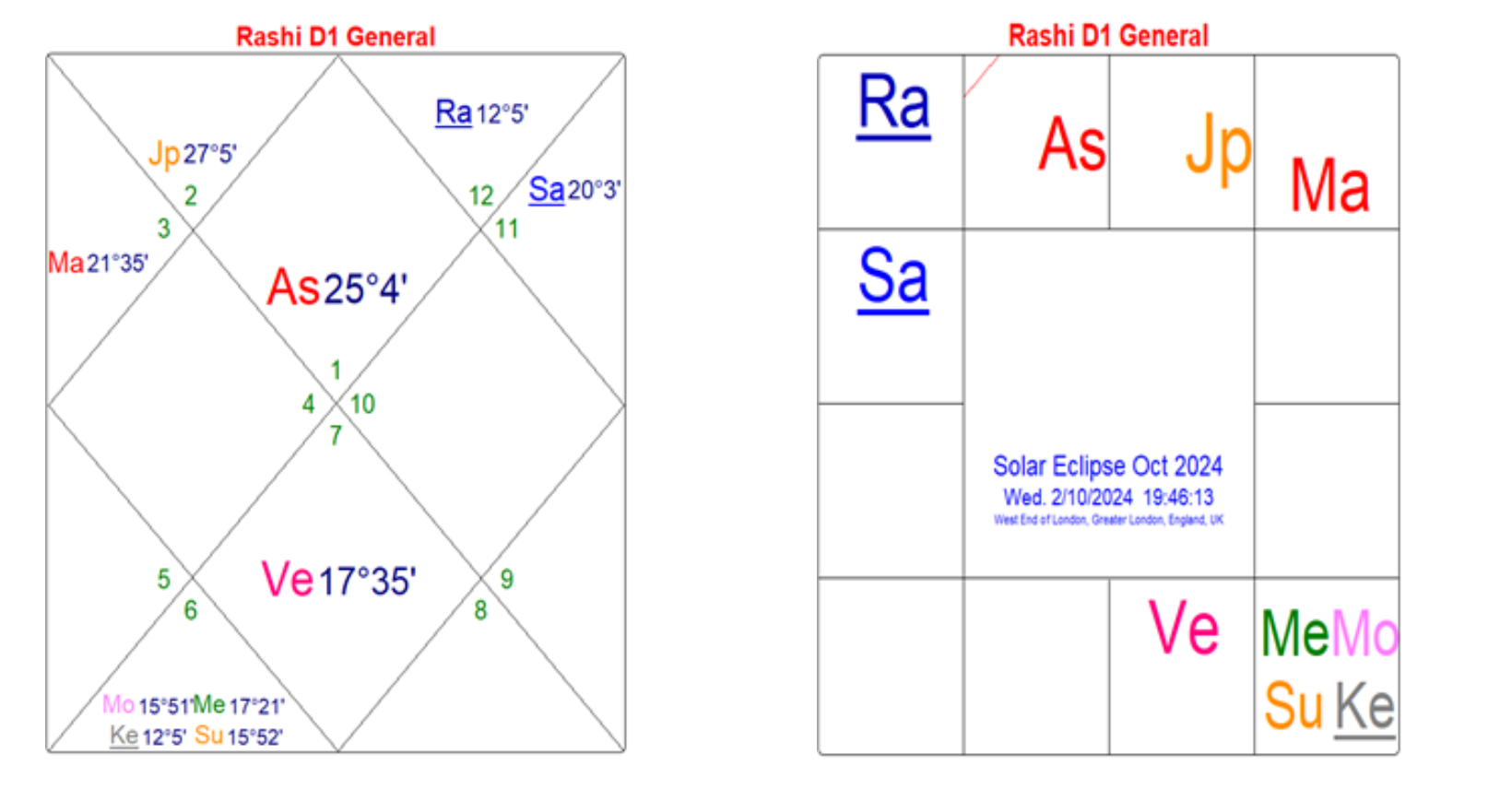
 

Using the progressed chart for UK (progressing the original 1801 chart for 144 years),  the eclipse ascendant Aries is the 9th house of fortune in the natal progressed chart.  The eclipse itself is in the 2nd house in Virgo pointing to finances and debt. Prime Minister Sir Keith Starmer has said “that things will get worse before they get better, claiming that there is “rot deep in the heart” of Britain in an attempt to prepare the groundwork for sweeping tax increases in autumn. The presence of nodes in 2/8 axis often shows issues of grappling with finances and borrowings.  A retrograde Saturn in the 7th house with directional strength (looking at the chart from Leo ascendant) indicates a hard and uncompromising labour and demands. Apparently 50% of the £33bn fiscal black has come pay rises for public sector workers. Jupiter in the 10th is giving a sign aspect to the 10th Lord Venus indicating a reward from entrepreneurial efforts. However, we must note that the 11th lord Mercury is firmly stuck in the house of eclipse.

Using the technique taught by Pandit Sanjay Rath, we divide the night of eclipse into 7 parts  to see which parts of it fall at the time of full and peak eclipse.  As the full eclipse starts early in the evening it will afflict the hour ruled by Moon affecting merchants, dependant  woman, ministers and general public.  The time ruled by Sun comes  after the eclipse and therefore the rulers and heads of State such as the Prime Minister are likely to gain in the next 6 months. The positive read on the hour ruled by Sun should also bode well for the Royality – House of Windsor.  The 10th house of the horoscope of William, Prince of Wales, has two planets Saturn and Mars (his ātma Kārakā and amatya Kārakā) in the eclipsed Nakshatra Hasta. 10th house represents the throne. Malefic planets in the 10th house are not conducive for paternal happiness or health. His father, King Charles has been undergoing Cancer treatment.

Solar Eclipse and United States

In the case of USA, the progressed ascendant (progressing the original 1776 chart by 144 years) is Scorpio. When we cast the chart for the peak solar eclipse in Washington DC at 14.46.13, we get the eclipse ascendant as Sagittarius with Jupiter in the 6th house of battle.  Challenges to throne and power are indicated by the eclipsed house Virgo falling in the 10th and the ruler of the 5th house of power Mars being in an unfortunate position (marana- death like) in the 7th house. From the natal progressed chart (Scorpio) the ascendant of the eclipsed chart is the 2nd house and Virgo the eclipsed house is the 11th house, both houses indicating  matters involving wealth and gains.
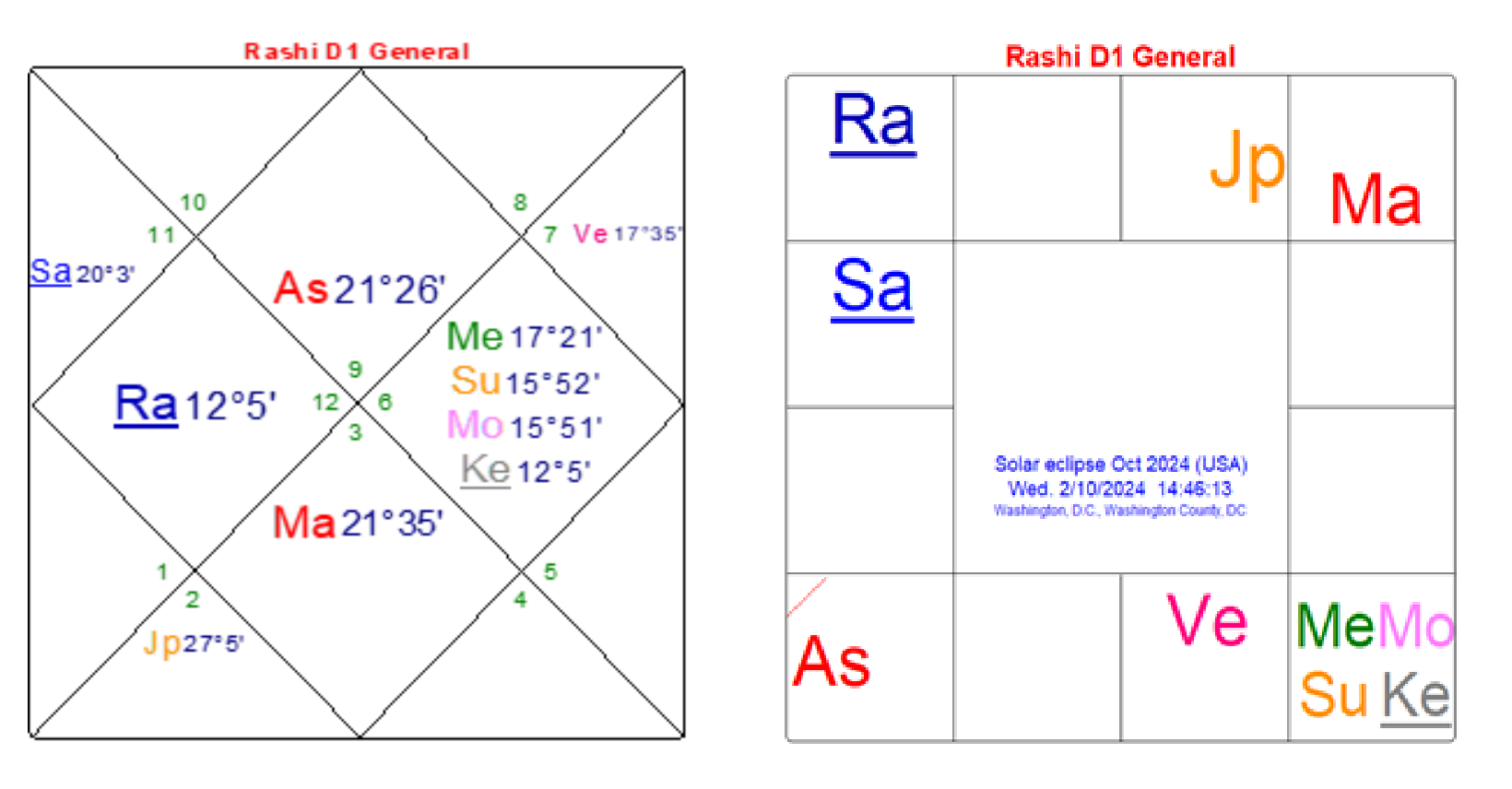
We  divide the day of eclipse into 7 parts  to see which parts of it fall at the time of full and peak eclipse.  The eclipse starts in the fourth part of the day ruled by the Sun and peaks in the part ruled by the planet Moon,  while receding in the part ruled by Venus. This indicates that rulers, kings, ministers and merchants would suffer with partial gains for independent women and travel. Matters represented by Saturn such as labour, borders areas and matters of migrants should prosper.  As the eclipse favours Saturn,  this should favour a more friendly foreign and immigration policy. As the hour of the Sun is disturbed, we cannot rule out unruly behaviour during the elections by the candidates or by the voters and/or disruption in timely hand over to the next government.

NATO and Solar Eclipse

The results obtained above from the calculations of the  division of the day of the eclipse in Washington is also applicable for NATO which is why I expected some disarray at the time of electing the new Secretary General for NATO which has not materialised. Mark Rutte  is expected to take over from Jens Stoltenberg on October 1st. In his leaving speech, Jens Stoltenberg talked of the relevance of NATO as an institution that is being united, strong and transformed.  We will see more of the transformation as there are two eclipses of 2025 are also in the Virgo/Pisces axis which forms the 1/7 axis of the horoscope of NATO.
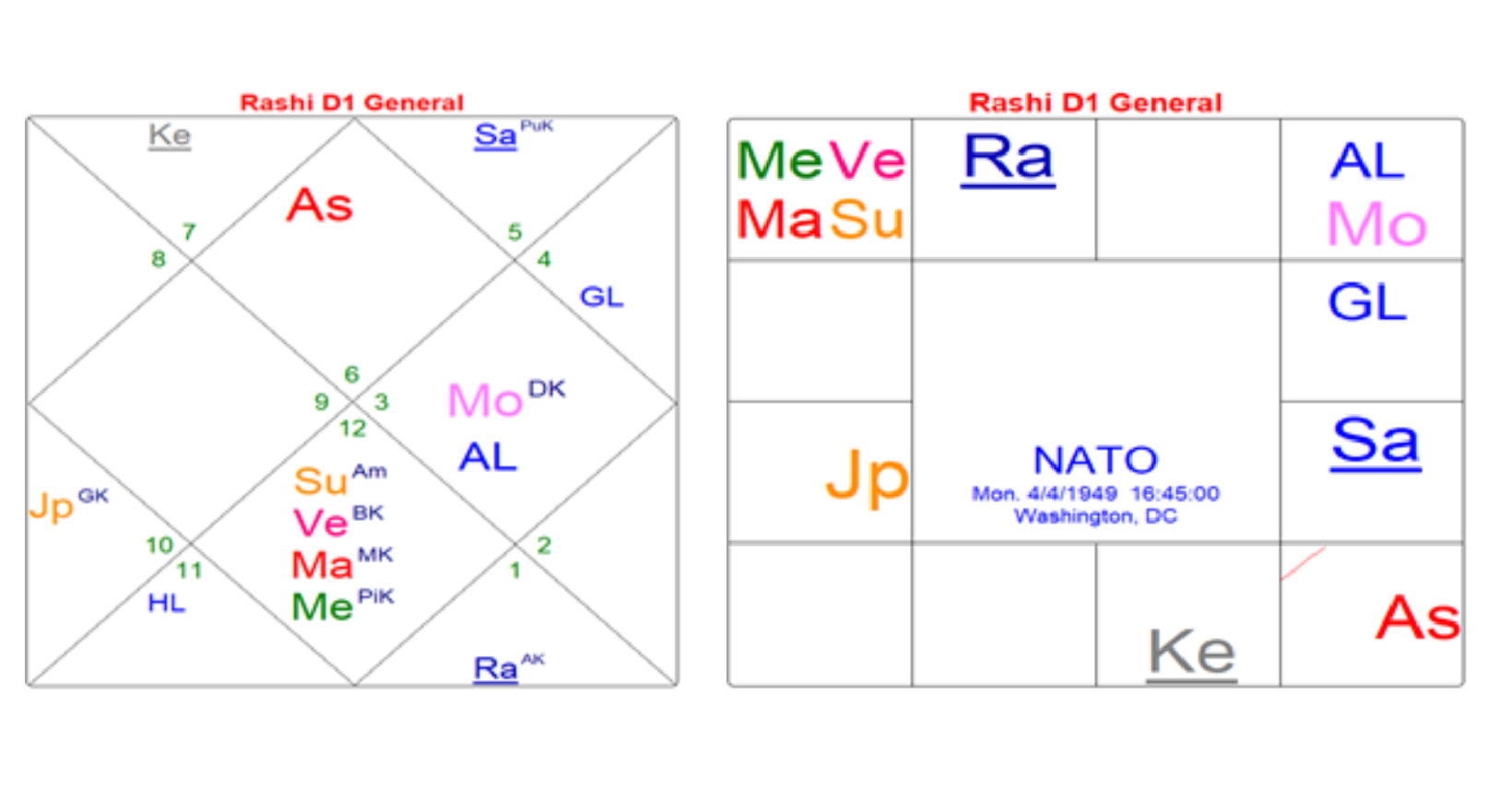
The eclipse ascendant for the chart cast in Washington at the peak hour of eclipse is Sagittarius, which is the is the 4th house for NATO that signifies territory and faith. Jupiter the ruler of Sagittarius is debilitated but gets a cancellation from Moon in the 10th house. The faith of NATO is in the strength of its allies which is the 11th house. Jens Stoltenberg  emphasised the importance of making sacrifices for peace by making contributions and choosing “freedom over free trade”. We can expect the continued momentum of the expansionary effort of NATO.  NATO is running the dasa of Ketu Rahu from 27/9/2024 to 15/10/2025. Actions taken in this period will have a karmic effect and can have deeper consequences for Europe and the world (read deployment of long-range missiles).  The antara of Jupiter that follows will provide room for negotiation.

When I look at the corresponding calculations for Russia, the eclipse starts in the hour of Moon, peaks at Venus. The eclipse also touches the partly the hour ruled by Sun, however it will be receding as it is after the peak time of eclipse. This shows that any leadership strength that is lost may be regained. However, I am mindful that Russia also has a Virgo ascendant implying big changes for the country will be forthcoming with eclipses continuing in Pisces/Virgo axis in 2025 which can signify changes in leadership.

References

Principles based on the teachings of Pandit Sanjay Rath on Solar eclipses

Bṛhat Samhitā – Varāhamihira, M. Ramakṛishna Bhat, Part 1, Motilal Banarasidass Publishers Pvt. Ltd, Delhi, India

Eclipse Data from https://eclipse.gsfc.nasa.gov/solar.html

Time and Date.com Solar & Lunar Eclipses Worldwide (timeanddate.com)



Uparati – Reducing Extrovertedness


`व्यां वेदव्यासाय नमः

vyāṁ vedavyāsāya namaḥ


July 21st is Guru Purnima giving us the opportunity to express gratitude to our Guru, mentors and teachers who are illumining our path. Five years ago, on this same occasion I started writing about the importance of observing śamādi-ṣaṭka-sampattiḥ or the six-fold inner wealth which forms the part “sādhana catuṣṭaya” or the four-fold qualification given in Tattva Bodha that facilitates spiritual learning. Every year I explore one quality in-depth for my development as my offering on this day. This year I want to explore uparati/uparama from the studies of texts and my understanding of it.

Uparati

Uparati from Monier Williams literally means “cessation, quietism, stopping worldly action, the prefix “upa” negating the meaning of the word rati from the root raṁ that is synonymous with enjoyment and pleasure. The name Rati thus is appropriate for the consort of the Vedic God of love Kama. Uparati then is the cessation of the  needless worldly activities to maintain the equanimity and restraint gained from the qualities of śama and dama – mind and sense control. The state of Uparati assumes that seeker has knowledge and spirit of renunciation.

Here, I want to remind myself of the metaphor of a chariot (representing our body) from Kaṭhopaniṣad (1.3.3-11) used to describe the relationship between the senses, mind, intellect and the Self. The reigns (mind) should be tightly held by the charioteer (intellect) to reach the destination otherwise the Self (passenger) can run amok  pulled by the five horses (senses) that dwell on what life throws in its way. Uparati helps us stay on course by making the right choices.

Exploring the meanings of Uparati from scriptures

Shankaracharya describes Uparati in Tattva Bodha (which is a beginner text in the path of Advaita) as “सर्वधर्मानुष्ठानमेव sarvadharmānuṣṭhānameva”. –  the strict observance of one’s own Dharma.

In the traditional Vedic sense, there  are five kinds of  karma  or Vedic rituals

  • Nitya karma are rituals which have to be performed on a daily basis – like prayer, bathing, veneration of ancestors, study or recitation of scriptures, service to others
  • Naimittika karma are special rituals which have to be performed on special occasions – birth, death and marriage.
  • Kāmya karma are rituals performed for the purpose of attaining prosperity, wealth, children or fame.
  • Prāyaścitta karma are rituals or remedial measures performed to reduce the effect of past activities.
  • Niṣiddha karma are forbidden and when performed result in the harm of others stealing, killing and indulging in all vices.

Of these five types of karmās,  the first two were considered spiritually uplifting and the latter three lead to spiritual stagnation or retrogradation.  It was generally recommended  to keen students to make room for the first two types of activities which are meant for spiritual growth and the gradual reduction of the latter three activities.

Later the same author, in the classical advanced scripture Vivekacūḍāmaṇi describes Uparati as  withdrawal where the mind stops responding to external objects. “The best Uparati or self-withdrawal is when the mind-function ceases to act by means of external objects”.

बाह्यानालम्बनं वृत्तेरेषोपरतिरुत्तमा ॥ २३ ॥

bāhyānālambanaṃ vṛttereṣoparatiruttamā || 23 ||

This meaning may be the close to the concept of pratyāhāra of Patañjali sūtra (verse 2.54). Hariharananda in his commentary explains that this involves indifference to external objects and living in the world of thought. The task here is to convert dispassion gained from the spirit of renunciation into indifference. This meaning of Uparati is more applicable for a disciplined student to cease being enamoured by the world and create space for contemplation.

Finally, for an advanced seeker,  Ādi Śaṅkarācārya gives the meaning of Uparati in Sarva Vedānta Sāra as entering into the Saṃnyāsa Āśrama  or taking a monastic lifestyle. He eloquently argues in 56 verses (152 -208) that the motives and means for path of karma and jñāna are different and seeks the renunciation of “vihita karma -strict religious Vedic rituals” for a qualified person seeking liberation to enable them to focus on contemplation and assimilation of knowledge.

Uparati in current Life

Uparati is the act of reducing extroverted-ness to be able to focus on the final puruṣārtha of moksha – liberation. Even if one is not interested in that goal,  reducing extroverted-ness  can be  beneficial for better focus on our development goals and outcomes. We are victims to a plethora of  objects these days both living and non-living devices that distract us and that has been further compounded by the introduction of artificial intelligence ( AI) which is employed to find what we like to enable us to receive more of that.

While Śaṅkarācārya called for a “hard stop” on karma activities – especially the Vedic rituals to find more space for contemplative studies and thinking,  these days this concept is hardly relevant as there are few that follow the karma kāṇḍa – path of religious rituals. Perhaps cultivating a feeling of contentment and inner renunciation is sufficient rather than taking to the robes. Svāmi Paramārthānanda of Arsha Vidya explains that mere external renunciation without feeling it internally is dangerous for the society.  Sri Krishna in verse 3.6 of Bhagavad gītā  calls such a person as a hypocrite “Those who restrain the external organs of action, while continuing to dwell on sense objects in the mind, certainly delude themselves and are to be called hypocrites”

कर्मेन्द्रियाणि संयम्य य आस्ते मनसा स्मरन् |

इन्द्रियार्थान्विमूढात्मा मिथ्याचार: स उच्यते ||3.6||

karmendriyāṇi sanyamya ya āste manasā smaran

indriyārthān vimūḍhātmā mithyāchāraḥ sa uchyate

Svāmi Paramārthānanda has suggested that the varṇa  āśrama – going through the four stages of life (from brahmacharya-grhasta-vānaprastha-saṃnyāsa ) is more conducive as it provides opportunity of gradual reduction of responsibilities and hence our attraction to the external world. However, I find that these days the stages of varṇa āśrama are increasingly blurred as people are marrying later, becoming parents much later in life and also seeking opportunities to remarry till end of life leaving  less opportunity for inner renunciation.

Path to Uparati

Svāmi Paramārthānanda recommends the study of Bhagavad gītā  for all without consciously thinking about one’s path – being in karma or jñāna to improve awareness and to make conscious choices after gaining knowledge.

The preliminary step in reminding ourselves whether we are ready for Uparati is the proper understanding of karma yoga. The following for steps are recommended for a seeker while being in every-day life

  • Reduce the qualities called āsuriṁ  saṁpat given in Chapter 16 of Bhagavad Gītā – those that increase aggression and coveting -viz.   dambha  – ostentatiousness and hypocrisy; darpa – arrogance; abhimānaḥ – Self-conceit, excessive self-worth and identity; krodha – anger; pāruṣhyam – harshness and ajñānam – ignorance. The Patañjali Yoga sūtra recommends aparigraha – non-grasping of material things for being a true yogi.
  • Increase the 26 qualities of devi saṁpat given in the same chapter 16 for maintaining purity, self-restraint, keeping on the path of knowledge
  • Trusting oneself to a higher force, mentioned as niyama (things to do) Īśvarapraṇidhāna in the Patañjali yoga sūtra
  • Cultivating an attitude of prasāda buddhi- of gratitude and acceptance of what comes our way

It is only true inner renunciation that makes way for wisdom in the being while the fruit of spiritual wisdom leads to Uparati, cessation of fascination for things external.

References

  1. Svāmi Paramārthānanda’s teachings on Tattva Bodha, Bhagavad Gītā , Kaṭhopaniṣad, Viveka Cūḍāmaṇī, and Sarva Vedānta  Siddantha Sāra Sangrah
  2. Yoga Philosophy of Patañjali – by Swami Hariharananda Aranya


ॐ तत् सत्