
Chaitra Śukla Pratipada, the first lunar day following the New Moon in Pisces, marks the beginning of the lunar year known as Samvatsara and serves as the foundational chart from which the collective destiny of nations is assessed. The year is Parabhava, meaning “defeat” or “downfall,” concluding the eighth lustrum ruled by the Viśvadevas. Traditionally, it is associated with conflict, fire, weaponry, disease, sorrow, and heightened vulnerability among intellectuals, the marginalised, and livestock. Its symbolism aligns closely with the current global climate, characterised by war, geopolitical tension, trade disputes, strategic rivalry, and increasingly fragmented cooperation as the year begins on March 19.
As noted in the solar eclipse analysis, Rahu and Ketu transiting the Aquarius–Leo axis (May 2025–December 2026) intensify the tension between collective systems and individual authority. Ruled by Saturn and the Sun respectively—planets representing opposing principles of discipline and ego, structure and leadership—this axis reflects a struggle between institutional control and personal power. Rahu in Aquarius accelerates societal restructuring through political movements, ideological reform, and technological disruption, often producing gains through unconventional or crisis-driven channels. Consequently, capital has favoured sectors such as precious metals, technology, defence, and aerospace. Conversely, Ketu in Leo signifies detachment from status and centralised authority, frequently manifesting as weakened leadership, abrupt resignations, or the erosion of personality-driven regimes. Since mid-2025, several nations have experienced regime instability or political collapse, reflecting this broader theme of diminishing personal power.
Saturn’s transit through Pisces since March 2025 has slowed the healing and resolution normally associated with this sign. While Pisces seeks reconciliation, Saturn imposes delay, caution, and realism, prolonging negotiations and peace processes. Its combustion heightens public sensitivity and restraint, demanding accountability and practical reform over idealism. The concurrent presence of an exalted Venus provides a moderating influence, encouraging diplomacy, compassion, and humanitarian considerations that may soften otherwise severe outcomes.
At the same time, planetary concentration across three houses forms a Śūla Yoga, creating urgency, pressure, and decisive turning points. Jupiter’s aspect from Gemini supports dialogue and adaptability, while Venus with Saturn favours negotiated settlements. All planets lie between Rahu and Ketu, forming a Kāla Amṛta Yoga that compresses planetary energies and intensifies destiny-driven developments, often placing strain on governments and institutions and exposing structural weaknesses that demand reform.
Against this broader backdrop, the Chaitra Śukla charts of major powers and alliances illustrate how these collective pressures are likely to manifest at the national level. The principal themes are summarised below, with detailed analysis provided in the sections that follow.
The principal astrological configurations for each national chart are summarised below before the detailed interpretations.
| Country / Entity | Rising Sign | Natal House Activated | Ascendant Lord Placement | Hora Lord | Hora Lord Placement | Key Themes |
| UK | Sc | 4th house – public, land, domestic governance | Mars in 4th house
with Mercury |
Su | 5th house of power, creativity | Domestic focus. Governance and fiscal pressures dominate, producing political rivalry causing existential crisis with heavier reliance on taxation and debt restructuring. Healthcare and public systems face strain, though selective gains may arise through financial and speculative activity. |
| EU | Sc | 3rd house – agreement neighbours, alliances | Mars in 4th house with Mercury influenced by Rahu | Su | 5th house of power, creativity | Focus on bloc cohesion, negotiations, and alliance management. Expect change in leadership or objectives; gains may arise through regulatory enforcement, conflict-war, and restructuring and speculative activities. |
| USA | Li | 12th house – foreign affairs, expenditure, borders | Venus in 6th house (Marana Karaka Sthana) | Me | 5th house of power and creativity | External obligations, border concerns, and institutional vulnerabilities drive political aggression and volatility, bringing hidden liabilities. Leadership stabilises after early stress, while defence, aerospace, infrastructure and technology-linked sectors support financial resilience despite broader turbulence. |
| NATO | Li | 2nd house – funding, resources, member contributions | Venus in 6th house with Saturn | Me | 5th house of power and creativity | Financial sustainability and burden-sharing come under scrutiny, necessitating disciplined reorganisation and changes to funding structures and membership commitments. Leadership consolidates, but operational and coordination challenges persist. |
| China | Ta | 5th house – state power, reputation, strategy | Venus exalted in 11th house with Sun and Saturn | Ve | 11th house | Commercial conditions remain comparatively resilient with opportunities for gains, supported by fiscal strength, though legacy pressures from industrial overcapacity and real estate continue. Leadership remains strong, though challenges are likely to emerge with the shift of the Rahu–Ketu axis later in the year. Sporadic disruptions and border tensions may persist. |
Chaitra Śukla Pratipada for UK 2026-2027
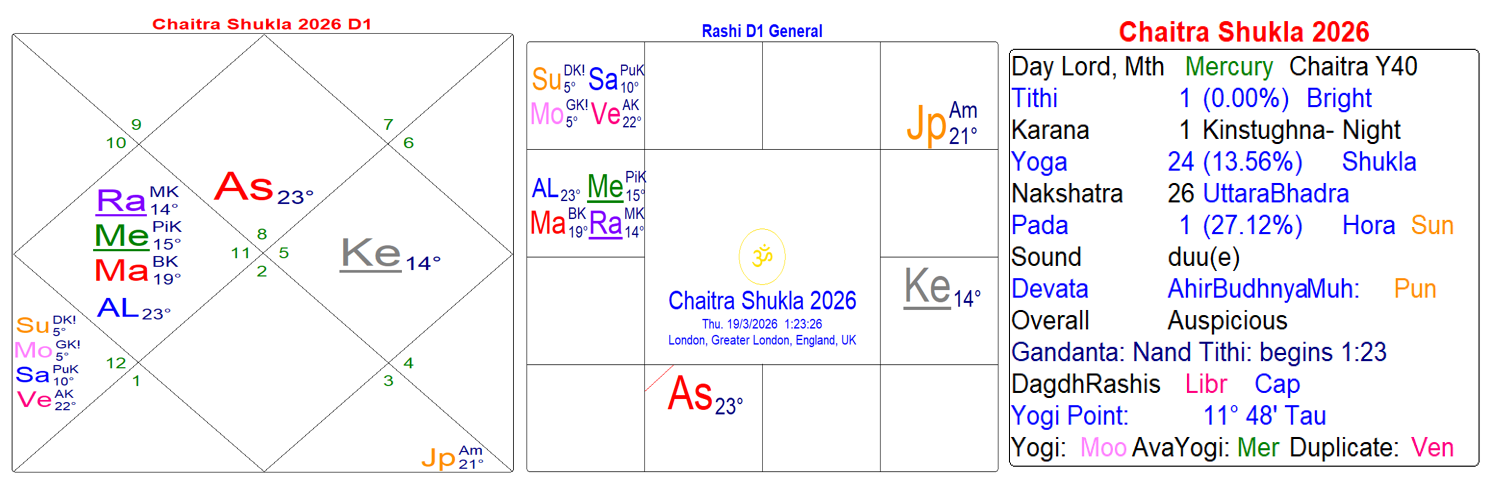
The ascendant for London, United Kingdom, falls in the fixed sign of Scorpio, which represents the fourth house of happiness, the public, property, and agriculture in the nation’s natal chart. The ruler of Scorpio, Mars, is positioned in the fourth house along with Mercury, the lord of the day, placing emphasis on domestic affairs. The Sun, acting as the Hora Lord, brings the significance of authority and governance into play. The combination of Mars and Mercury indicates intense political rivalry, likely taking place behind the scenes since both planets occupy the constellation of Shatabhisha. Rahu’s influence adds elements of hostility and misinformation. Rahu and Mercury, as lords of the eleventh house of gains, positioned in the fourth house, suggest a strong dependence on the public and taxation for revenue. However, due to retrograde movement, policies arising during this period may face challenges and require revision.
The presence of exalted Venus conjoined the Sun and Moon promotes diplomacy and cooperation in foreign affairs, consistent with its rulership over the seventh and twelfth houses. Saturn’s association, however, tempers this with caution and procedural discipline, suggesting that any rehabilitation or reform measures will be gradual, formal, and administratively controlled rather than swift.
The concentration of planets creates a pressured and reactive policy climate, with firm measures that may feel demanding for the public. Nevertheless, Jupiter’s aspect on the fourth house provides a degree of protection. Positioned as the ruler of the second and fifth houses and placed in the eighth, Jupiter indicates financial stability through an increase in creative debt management and speculative financial markets.
The recent solar eclipse peaking in the hour of Sun in February 2026 signalled an existential challenge for Prime Minister Keir Starmer and his cabinet, a strain that has become increasingly visible over the past six months. Analysis of the forthcoming eclipses further highlights vulnerabilities within healthcare systems, particularly the NHS, along with continued stress on broader business conditions.
Chaitra Śukla Pratipada for EU 2026-2027
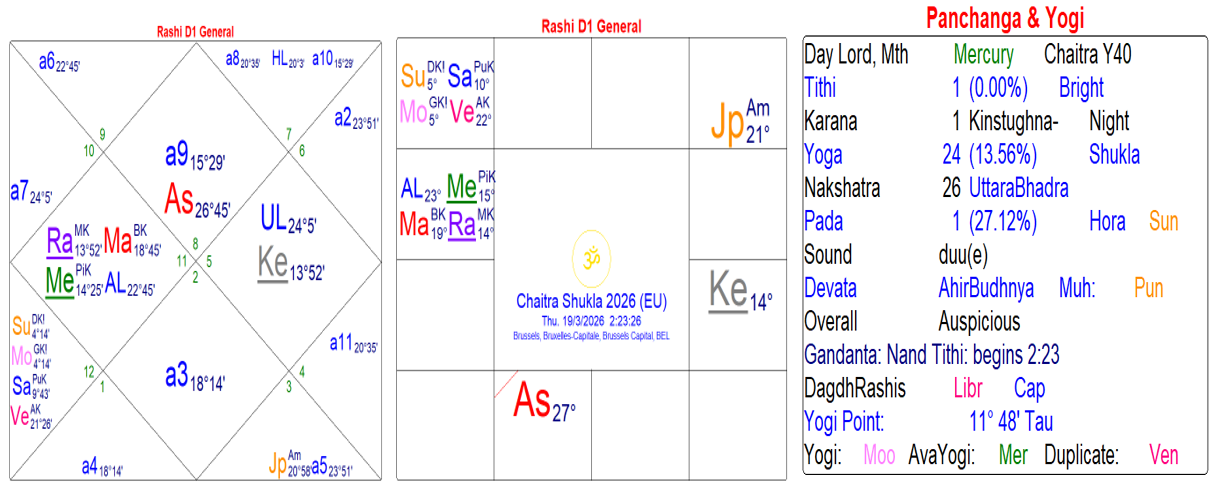
The Chaitra Śukla chart for the EU rises in Scorpio, which corresponds to the third house of contracting, immediate neighbours and agreements in its natal horoscope. This places primary emphasis on consolidation, strategic partnerships, and the strengthening of bloc cohesion. Mars in the fourth house alongside Mercury, influenced by Rahu, indicates internal political competition, tactical manoeuvring, and episodes of misinformation and domestic dissatisfaction. With Aquarius governing the sixth house, gains may arise through conflict or war, regulatory enforcement, or institutional restructuring.
The Hora Lord being Sun and placed in the 5th house of power brings authority and governance in to play. Exalted Venus supports diplomacy and cooperation, while Saturn tempers progress with procedural caution, suggesting that reforms will be gradual and negotiated. Jupiter’s aspect offers protection, favouring creative financial restructuring and speculative activities despite underlying pressures.
The February eclipse peaked in the hour of Sun signalling changes within leadership and the forthcoming one in August indicates issues with border areas.
Chaitra Śukla Pratipada for US 2026-2027
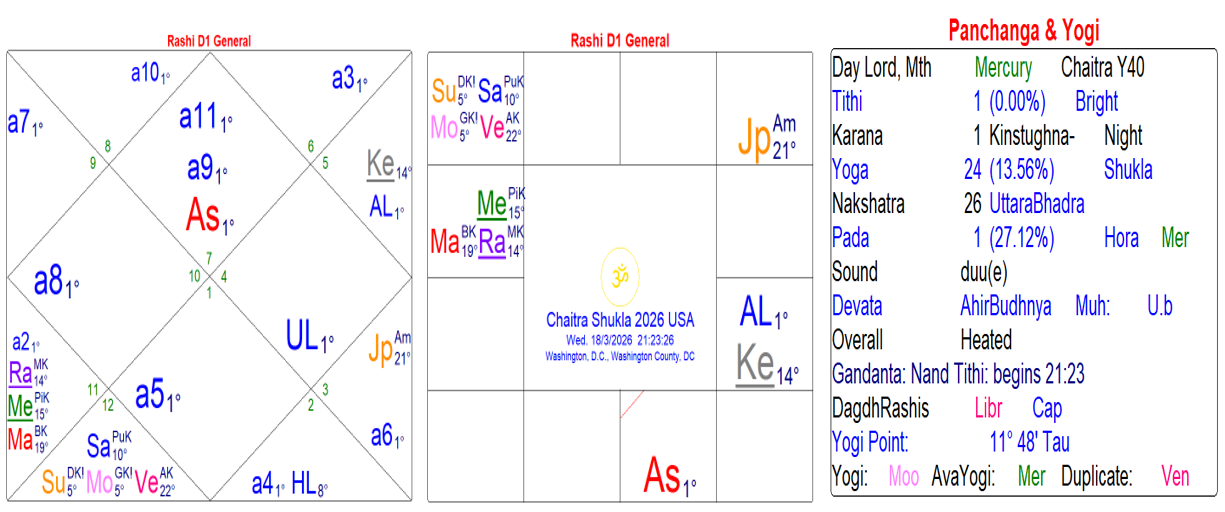
The ascendant falls in Libra, corresponding to the twelfth house of the natal chart, which governs expenditure, foreign relations, neighbouring nations, immigration, and border control. This immediately places emphasis on external obligations, fiscal outflows, and matters concerning national boundaries. The ascendant lord, Venus, occupies the sixth house in Marana Karaka Sthana, directing attention toward war, obstacles, and structural vulnerabilities within national institutions. Its condition indicates strain across administrative and social frameworks. Further affliction from Saturn and the Sun points to entrenched or legacy challenges, particularly in foreign and immigration policy, border management, and relations with other states.
Mercury, as both the day lord and Hora Lord assumes central importance for the year. Representing the head of state, Mercury is retrograde in Aquarius in the fifth house, conjoined Mars and Rahu. This configuration suggests heightened political competition, strategic manoeuvring, and repeated efforts to consolidate authority and manage alliances. The recent war in the middle east will result in huge liabilities for USA as Mercury rules over the 8th house.
Jupiter’s aspect to the fifth house provides a moderating influence, helping preserve financial stability despite turbulence. Mars, as second lord, placed favorably, supports gains through war, engineering, infrastructure, logistics, and market-driven or speculative sectors, while Ketu’s position in the eleventh indicates windfall opportunities and wealth accumulation from technology and aerospace industries.
Overall, the chart favors decisive and assertive governance, often reactive and security-focused, suggesting a nation compelled to act boldly under pressure, particularly in matters of defense, enforcement, and strategic control.
The February solar eclipse marked a challenging phase for political leadership, as well as for judicial and academic institutions, while simultaneously strengthening defense and security sectors. Subsequent eclipses in August 2026 and February 2027 indicate an initial weakening of leadership followed by consolidation and recovery of authority, whereas military and defense advantages may gradually face operational or structural strain.
Chaitra Śukla Pratipada for NATO 2026-2027
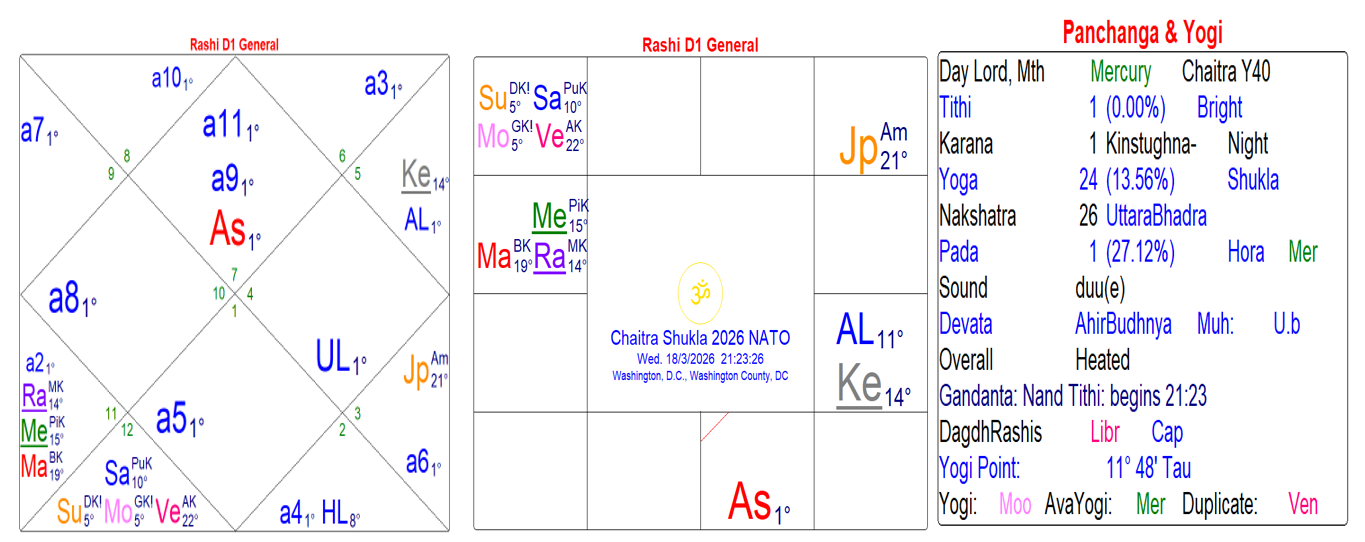
NATO operates under the same annual chart framework as the United States, as its place of incorporation is Washington, D.C. In this chart, the ascendant falls in Libra, corresponding to the second house of wealth, funding, and collective resources. This immediately directs attention toward questions of financial sustainability, shared contributions, and the cohesion of member states—specifically, who participates, at what cost, and under what obligations.
The ascendant lord, Venus, occupies the sixth house in Marana Karaka Sthana, indicating stress, disputes, and operational strain despite its exalted dignity. While Venus normally promotes cooperation and alliance-building, its placement in the house of conflict suggests that partnerships may be tested through disagreements over burden-sharing and strategic priorities. Venus is conjoined Saturn, lord of the fourth and fifth houses, further emphasising institutional pressure and responsibility. Together in the sixth, this combination points to structural strain within the alliance and the need for disciplined reorganisation. Additional affliction from the Sun highlights entrenched or legacy issues that could threaten cohesion if left unresolved. An exchange between the Sun and Ketu suggests shifts in funding patterns, with new financial sources or contributors emerging even as older ones diminish or withdraw.
Mercury, is both the day lord and the Hora lord represents the leadership of NATO. Mercury is retrograde in Aquarius in the fifth house and hemmed between Mars and Rahu. This indicates intense political manoeuvring, strategic competition, and complex negotiations, requiring deft management of alliances and repeated efforts to consolidate authority. Mercury’s rulership over the ninth and twelfth houses underscores themes of foreign relations, borders, and multinational cooperation, all of which demand careful handling. Again, Jupiter’s aspect provides some protection and stability.
The Śūla Yoga indicates NATO may be compelled to act decisively under stress, particularly in matters of security, defence coordination, and funding structures.
The solar eclipse in February signalled a strong period for Mars-related sectors such as defence and security forces. However, the subsequent eclipses indicate a weakening of this position due to operational challenges while leadership should strengthen.
Chaitra Śukla Pratipada for China 2026-2027
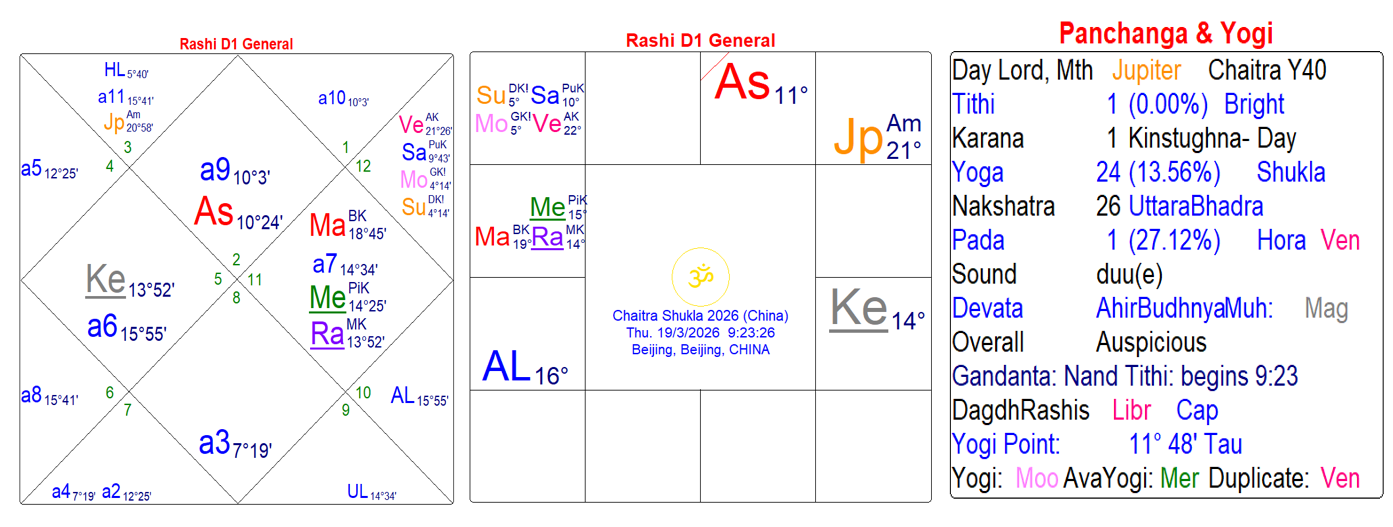
The ascendant for Beijing falls in Taurus, corresponding to the fifth house of creativity, reputation, and state power in China’s natal chart. Its ruler, Venus, also serving as Hora lord, is exalted in the eleventh house of gains and opportunities, conjoined the fourth lord Sun and the ninth lord Saturn. This alignment, linking the ascendant lord with the lords of domestic stability and destiny in the house of gains, supports profitable ventures. However, the Sun–Saturn conjunction also highlights legacy or structural burdens, particularly within the real estate sector and long-standing over-capacity issues.
Jupiter, as day lord and dispositor of the eleventh house, represents those in positions of authority. Placed in the second house of treasury, it favours wealth accumulation and fiscal strength, though its rulership of the eighth also suggests reliance on debt, leverage, or external capital. Meanwhile, Mercury, Mars, and Rahu in the tenth house indicate intense competition, assertive policy execution, and strategic manoeuvring at the highest levels of governance. Jupiter’s aspect provides moderation and protection, helping maintain balance amid aggressive activity.
The February 2026 eclipse suggested that leadership could consolidate or emerge strengthened, though this advantage may be temporary. As eclipses shift to the Cancer–Capricorn axis, activating China’s natal 1/7 houses, pressure increases on both leadership and economic partnerships. The August 2026 eclipse points to sudden disruptions affecting business, legal, or judicial sectors while simultaneously strengthening the military and security apparatus. The February 2027 eclipse further signals potential leadership adjustments—possibly due to health concerns or internal strain—alongside renewed border tensions. Despite these challenges, commercial activity and broader economic performance are likely to remain comparatively resilient.
ॐ तत् सत्
This is the original analysis of Vijaya Jyoti, copyright © 2026 vijaya.jyoti.com. All rights reserved. No part of this article may be reproduced or transmitted without proper attribution to the author and source.